



MOQ had a week that would have been difficult to sell as a product launch.
A production migration aimed for parity. Engineers checked whether their test records agreed about the version used. Someone remembered that an admission ticket should eventually expire.
For October 12–18, that is a rather encouraging collection of news.
Instagram Live changed the plumbing
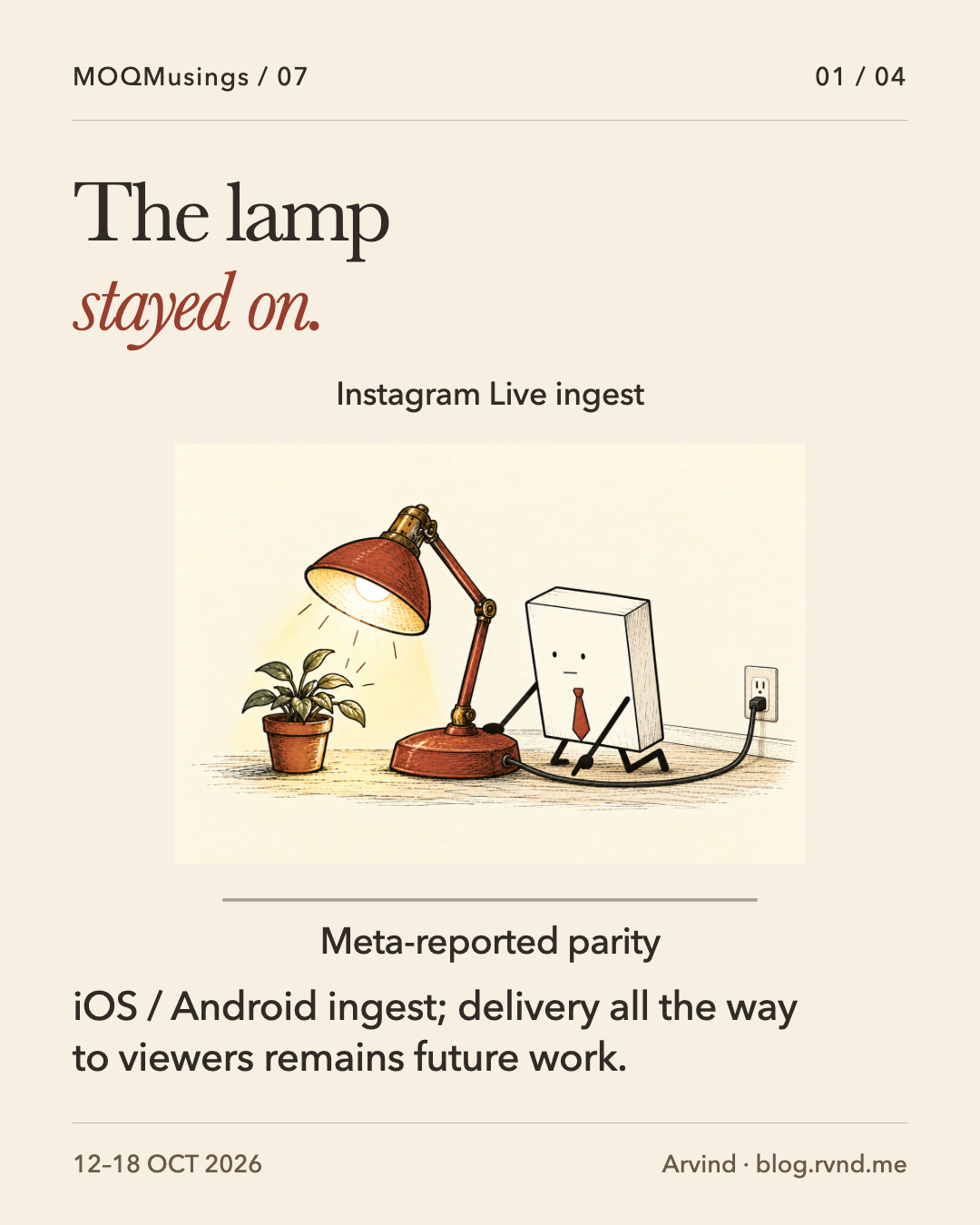
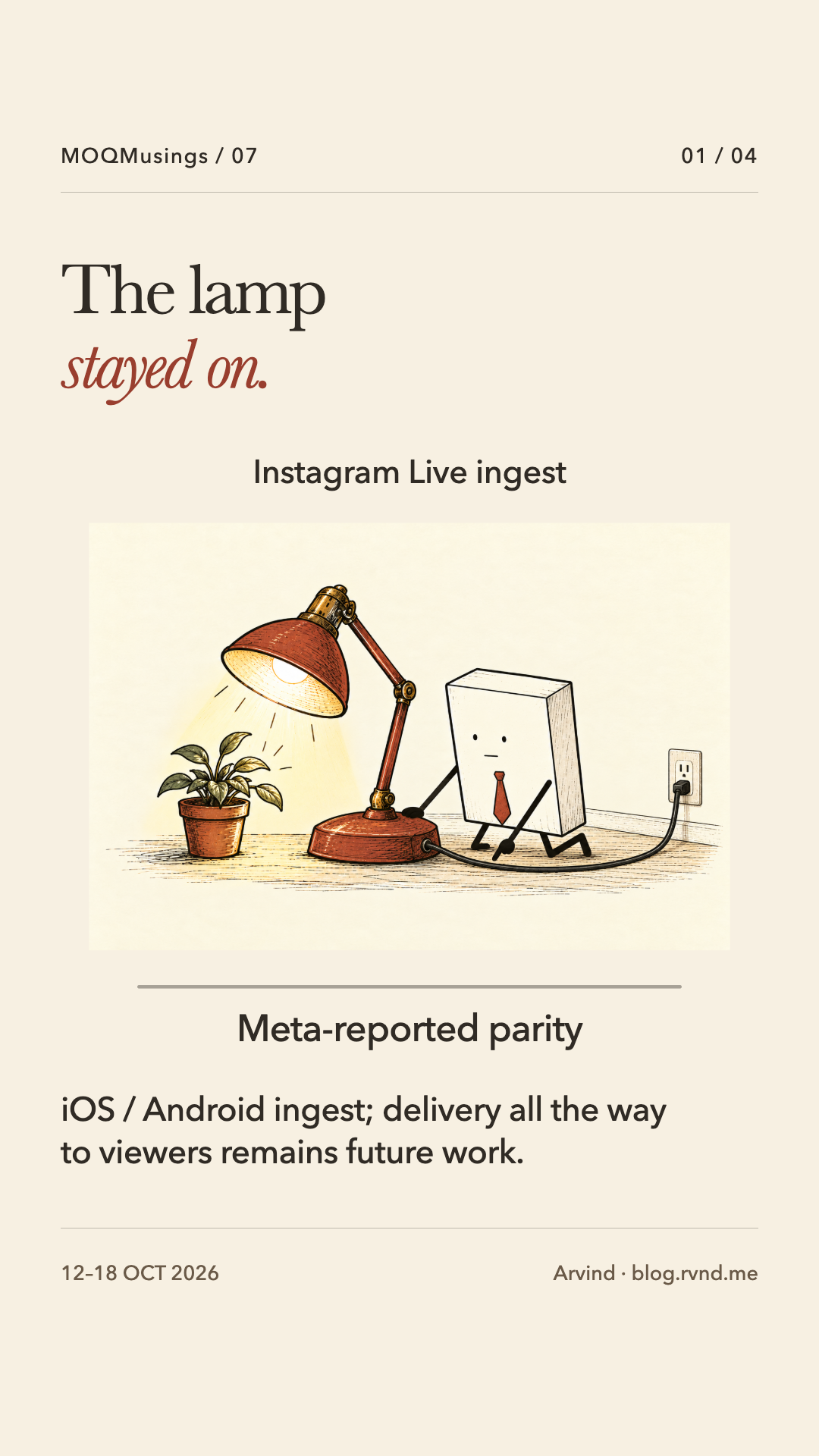
Last week's DEMOQED coverage left Meta's ingest talk as a lead to follow, rather than evidence of deployment scale. Meta's October 12 engineering report now describes MOQ shipping for Instagram Live on iOS and Android. This is the ingest leg: getting the creator's live media from their phone into Meta's systems.
Meta says the MOQ path matched RUSH, its existing live-streaming transport, on the rollout's quality and reliability measures. The report gives no public traffic count or measured latency improvement.
At the network edge, a translator converts the incoming MOQ messages into the RUSH format the existing backend expects. Networks that block QUIC still use RUSH's TCP fallback. A replacement fallback and MOQ delivery all the way to the viewer remain future work.
The achievement is replacing part of a running system without requiring everyone downstream to redecorate.
The viewers came for a live stream. A transport migration would have been an unusual bonus feature.
Seattle checked the version on the receipt
In the September 21–27 issue, Seattle's planned interop was still an "18/20 choose-your-own-adventure." The October 15 Seattle interim now gives us Mike English's interop report, with automated testing at 496 runs per night and a useful lesson about checking the version actually used.
In 76 test runs, clients reported which MOQ version they used. In 18 of those runs, the test report had assumed a different version.
The records disagree about which version was used. That does not mean 18 streams failed.
Even the test report needs a fact-check.
The report calls for recording more detail about each run and explicitly fixing the version under test. It also identifies media-level, end-to-end testing as work still needed. Two implementations can exchange valid protocol messages without proving that a viewer received the right picture.

Your subscription needs to renew its credentials
A media subscription is an ongoing request to receive a track, such as a live video feed. The auth design team's Seattle update asks what should happen when that feed is still running but the viewer's permission has expired.
The proposed approach keeps checking permission, makes the client responsible for renewal, and stops delivery when its authorization token no longer permits the request. The token's format would define the expiry and rechecking rules.
A subscription should not become a lifetime membership because nobody checked the clock.
This is design-team work, focused so far on permission between a relay and the receiving client. It has not been adopted into the core protocol, which remains Draft 22, covered when it arrived on October 1.

Built with MOQ: ask the publisher to show its work
Meetecho's media lab showed how to send and play media. Paul Gregoire's contribution interop runner checks the sender's protocol behavior.
This existing tool, highlighted in Seattle, acts as a receiving relay and checks the publisher's messages. Follow its Linux/CMake or Docker guide, connect your publisher, then inspect the JSON, TAP or HTML report.
Drafts 18, 21 and 22 are separate test targets; moq-lite-06 is another. It does not check the media itself. Its unauthenticated HTTP API needs a trusted network. Useful homework; no production-readiness certificate included.
After the switch
Meta describes how it replaced an ingest transport while preserving the existing backend. Seattle's test report shows why assumptions about versions need checking. The auth discussion asks when an ongoing media feed should stop.
These are questions operators eventually have to answer, even when the demo went beautifully.
MOQ kept the lights on. The test report would still like to know which version did it.