
Consider the week after a colleague is laid off. Their responsibilities begin appearing in your meetings. A deadline survives the departure of the person who was supposed to deliver it.
Your title hasn't changed, but your working day has.
You may understand the business explanation and still feel unsettled. You have lost someone you trusted, inherited decisions without their context, and started wondering what the next announcement might mean for you.
AI introduces another kind of uncertainty. A demonstration makes familiar work look effortless. You don't yet know how it holds up in practice, but someone will soon ask what it means for the team.
In an earlier edition, I wrote about influencing a new business direction while supporting an existing one. This time, the question comes closer to home: what do you do when that direction could change your own role?
There are useful steps you can take, and people who can help you think them through. A mentor's perspective can be especially valuable when you are too close to a situation to see your options clearly.
1. Separate the facts from the story you're telling yourself
You cannot settle every unknown before responding. Start by making one concern more specific.
There is emotional work here, too. The School of Life's Calm and Adaptability workshops address coping with uncertainty and reconsidering difficult situations. Feeling shaken deserves some room before it becomes another item on a self-improvement list.
Dale Carnegie's How to Stop Worrying and Start Living offers a practical next step: establish the facts, weigh them, decide, and act. His organisation still teaches this approach to decision-making.
Try it with one concern:
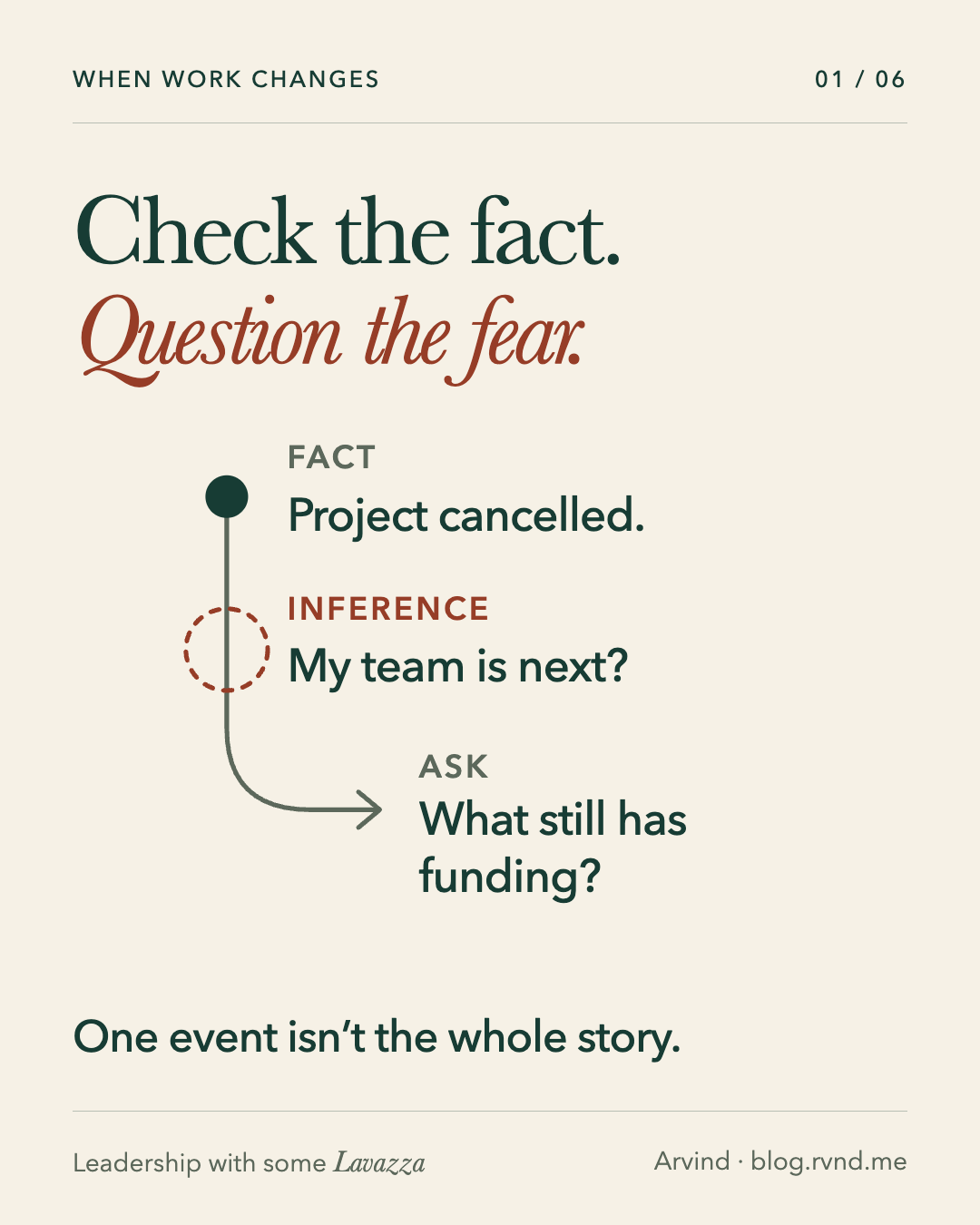
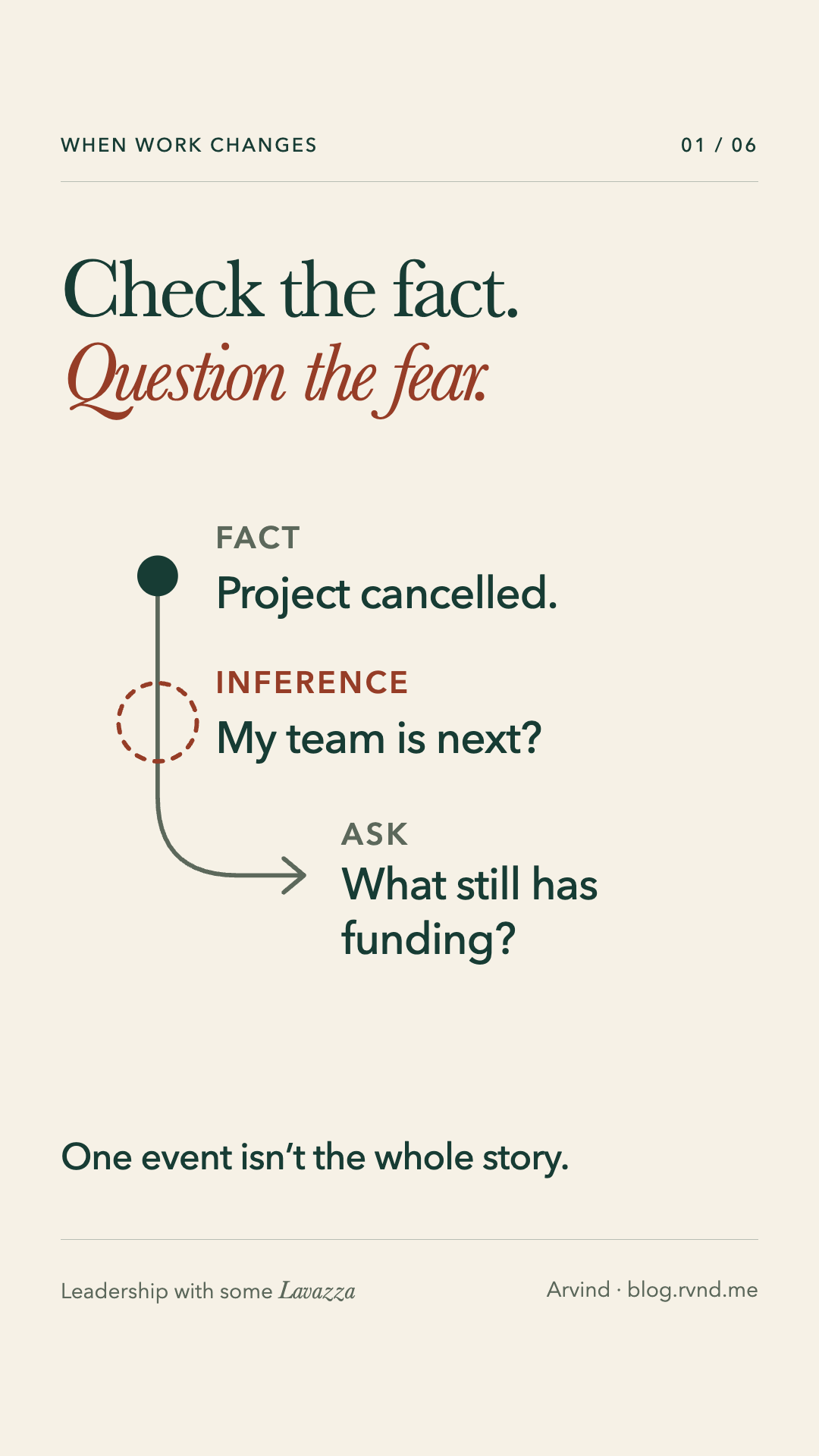
- What do I know? A project has been cancelled.
- What am I inferring? My whole team could disappear.
- What would help me decide? Understanding which priorities still have funding.
Take those answers to a mentor or trusted former colleague. Ask where you might be jumping to a conclusion, and what else could explain the facts. They may help you prepare a better question for your manager, even without knowing the answer themselves.
2. Give yourself a part in how AI changes the work
“Where does AI leave my profession?” is a difficult question to answer over coffee. Start closer to home: what could it change about your working day?
Look in two directions:
- Your immediate world: the analysis you prepare, the code you review, the customer questions you answer.
- Your adjacent world: the people whose work arrives at your desk, and those who depend on what you produce.
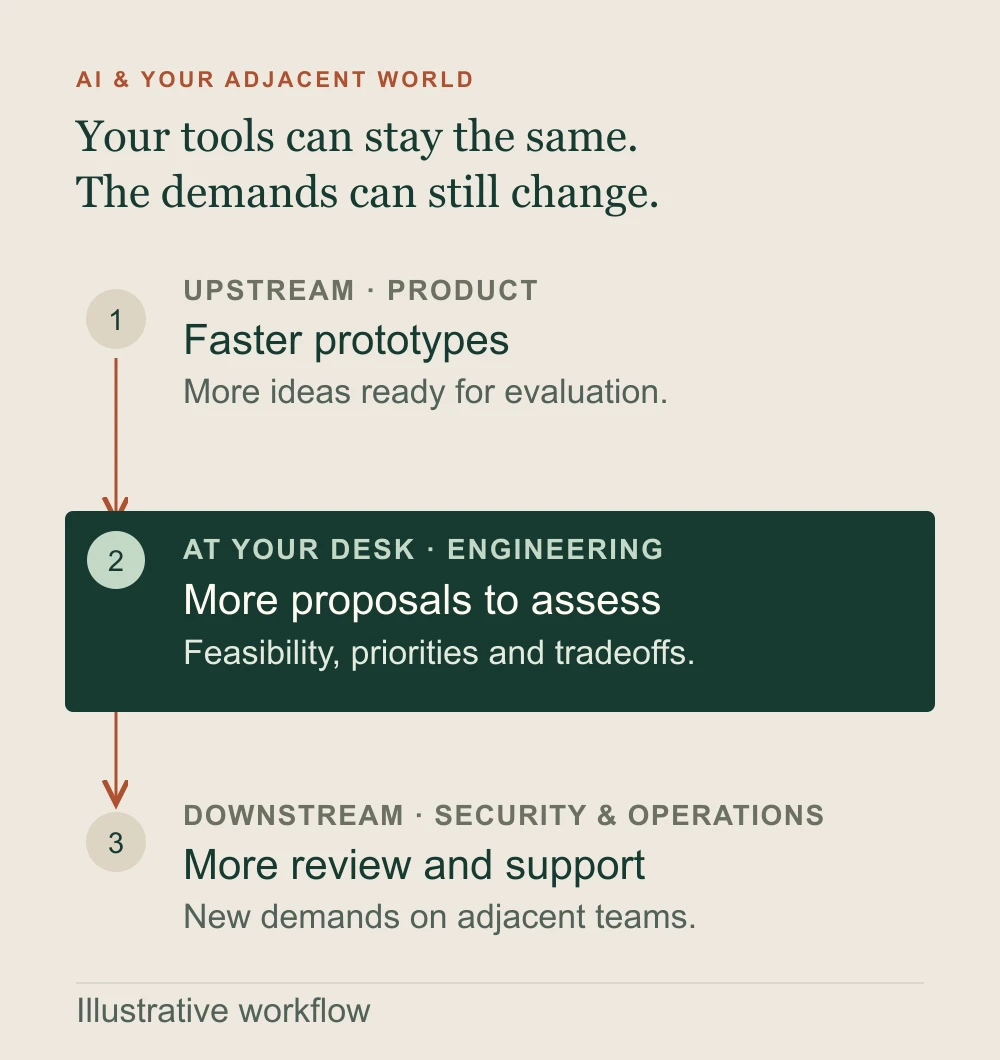
Suppose a product team starts generating prototypes faster. Engineering could receive more proposals, with security and operations facing more systems to review and support.
Your own tools might stay the same while the demands on your role change.
Could AI help you prepare a first summary of those proposals, leaving more time to assess the ideas? Exploring that question gives you experience to bring into the team's decisions. Waiting for someone else to work it all out gives them more say in those choices.
You don't need to predict the future to offer something useful.
Keep an open mind about the result. In a study of consultants using GPT-4, AI helped with some assignments but made correct answers less likely on another. Check your tools on work you understand.
Turn curiosity into one small experiment
Chip and Dan Heath's Switch: How to Change Things When Change Is Hard connects clear direction, motivation, and the conditions that make action easier. For the proposal example:
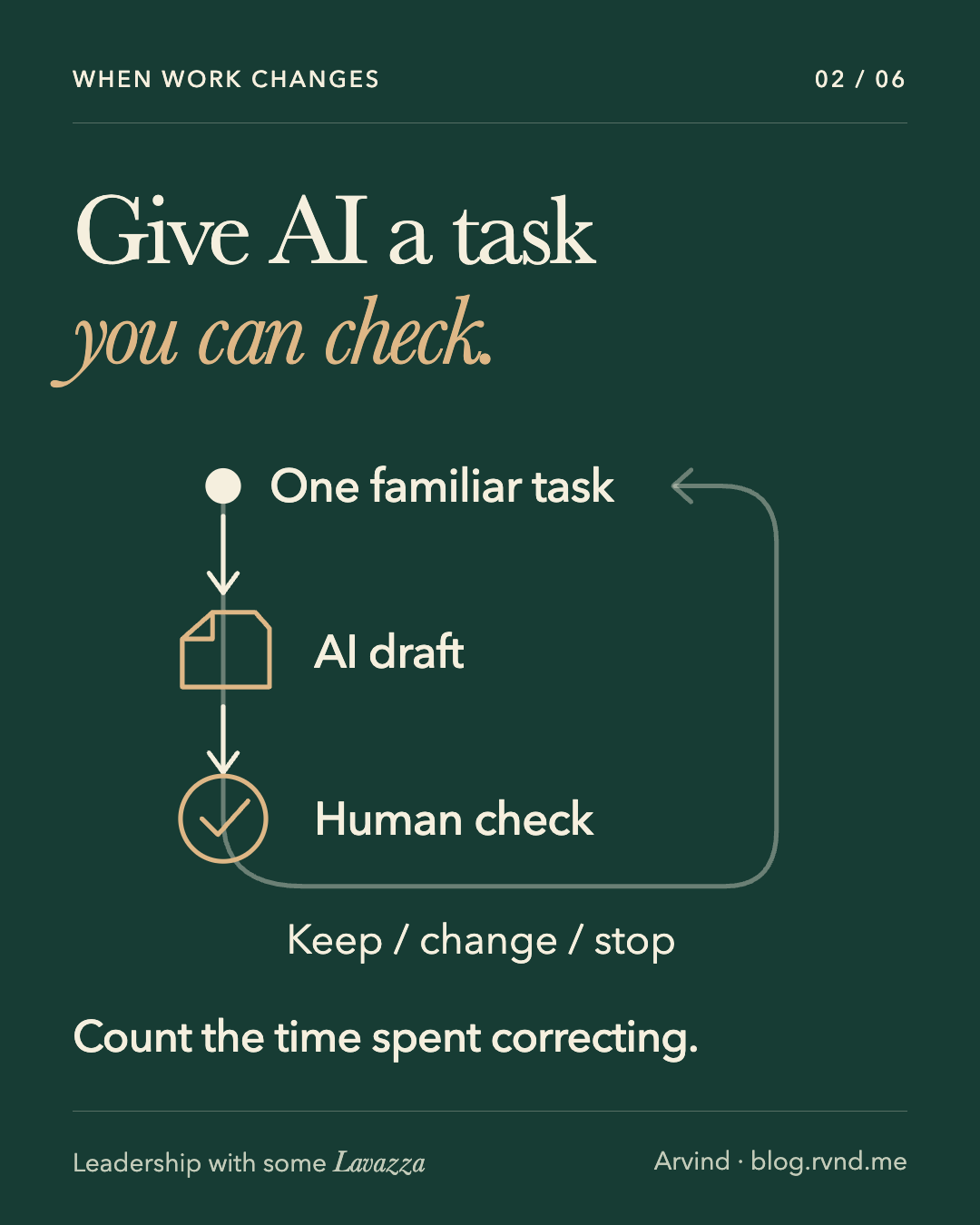
- Choose a clear first move — “Direct the Rider.” Pick one past proposal. Decide what a useful summary must include: the customer problem, the proposed approach, and the constraints.
- Make the change feel manageable — “Motivate the Elephant.” Choose a benefit you care about, such as spending less time writing summaries and more time assessing ideas. Keep the first attempt to one proposal, with human review in place.
- Remove the friction — “Shape the Path.” Set aside a short session with an approved tool and suitable material ready. Ask a colleague who knows the proposal to check for mistakes and missing context.
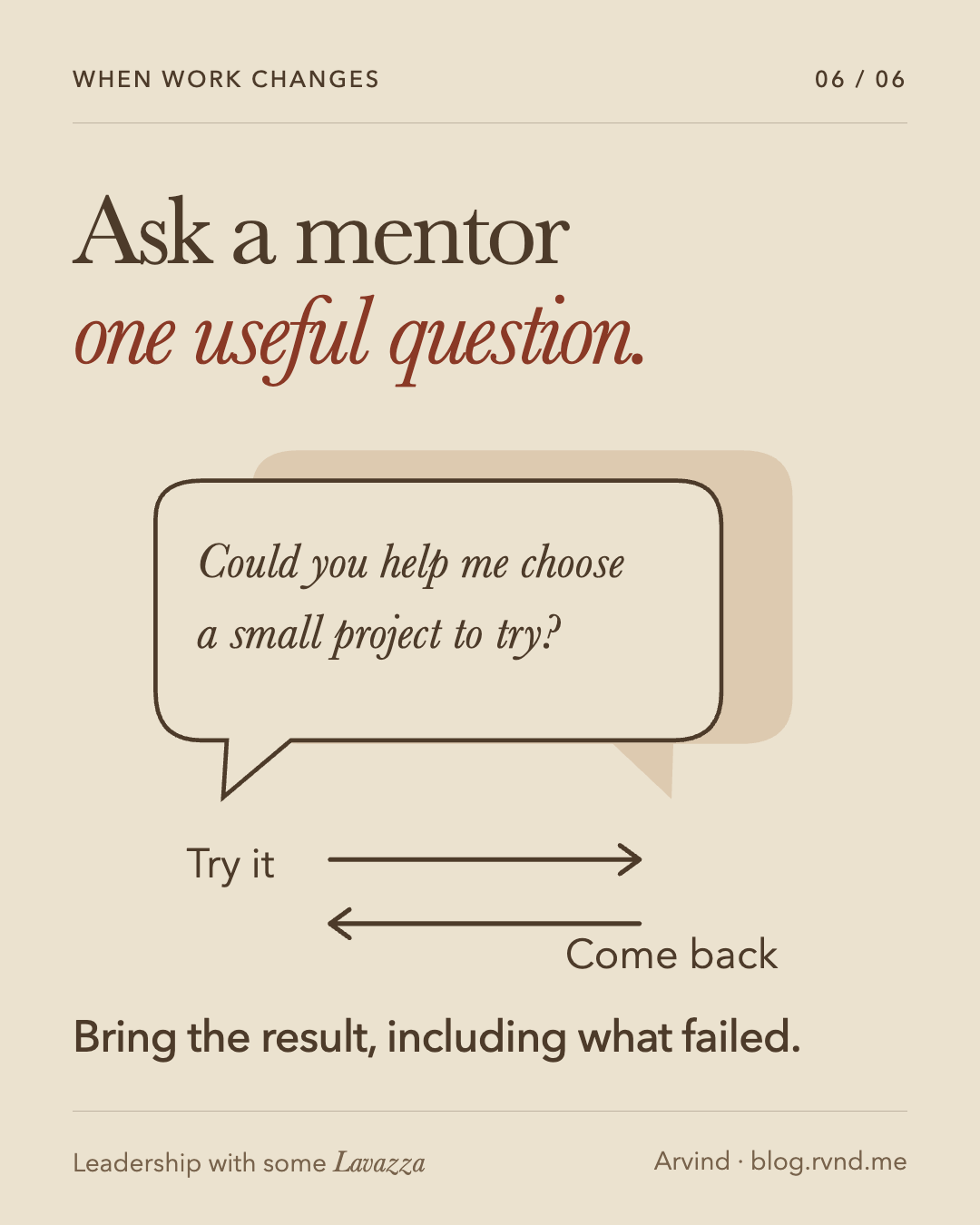
A mentor already using AI in similar work could help you choose the experiment and spot weaknesses in your approach. That person might be a peer with more hands-on experience. Bring the result back to them, including what failed.
Compare it with your usual process, counting the time spent checking and correcting. Bring what you learned into the next planning discussion: use AI for the first summary, adjust the review, or leave this task as it is.
3. After layoffs, ask what the business needs now
Even excellent people can lose their jobs in a budget cut. Understanding where your work fits helps you decide where to put your energy and when to explore other options. It cannot guarantee job security.
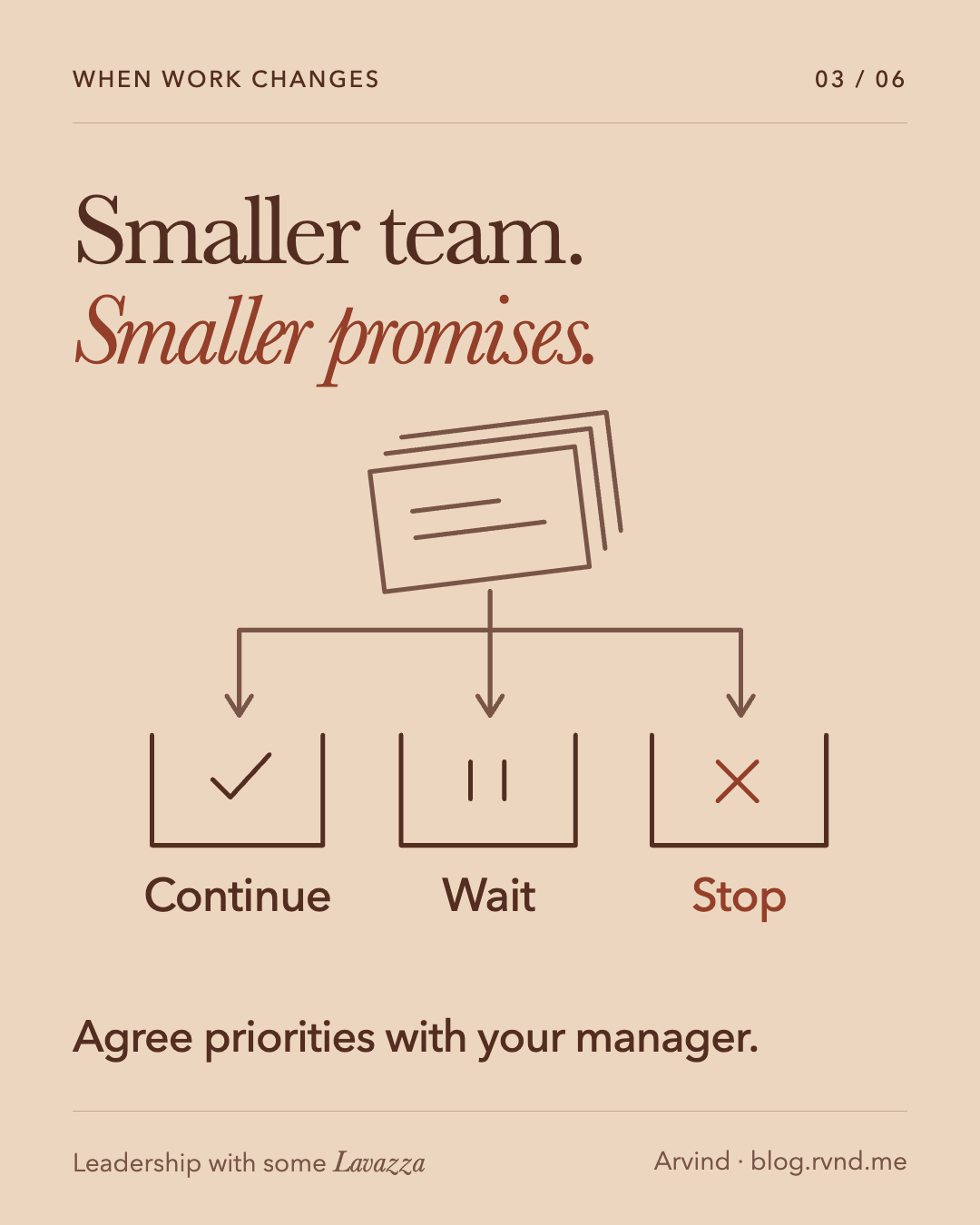
Start by agreeing what the smaller team can realistically take on.
List the work your colleagues have left behind. Take it to your manager and ask: what must continue, what can wait, and what can we stop?
If you lead the team, explain to your own manager which commitments need to change. Otherwise, people may keep planning as if the team were still the same size.
Then talk about the months ahead:
- What does the business most need from our team over the next six months?
- How will we know our work is helping?
- Which projects have a budget, and who decides whether they continue?
If the conversation feels difficult, rehearse it with a mentor who has led through a reorganisation. Ask how to explain the trade-offs and what follow-up questions they would bring. Your manager still needs to confirm the priorities; a mentor cannot do that for them.
As the weeks pass, compare the answers with what happens. Are important projects getting people and funding? Is anyone using what your team produces?
One missed meeting tells you little. If support keeps disappearing from work you've been told matters, ask what that means for your role. It may also be time to give other options more attention.
4. Give Plan B a place in your week
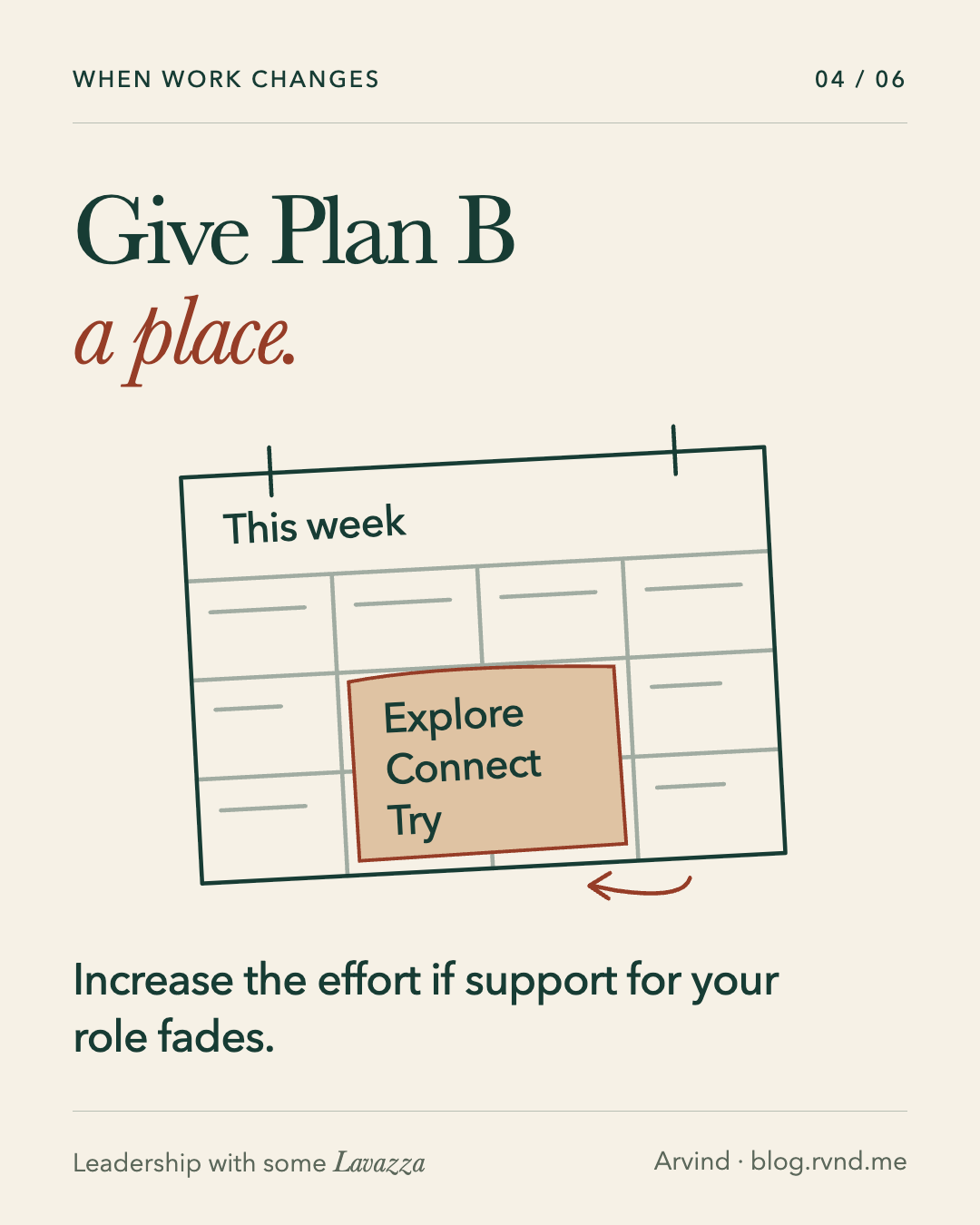
You can be committed to your work and still prepare alternatives.
Herminia Ibarra's Working Identity draws on research into career transitions to describe learning through experiments, relationships, and reflection. You can try aspects of a different role before committing to a move.
A mentor who has made a similar transition can help you choose a small project that resembles the work. Ask what surprised them about the role and which skills mattered once they were doing it. Use that perspective to test whether the work suits you.
How much time should you give it?
- Your role has clear backing. An hour outside work each week might be enough to update your experience, maintain relationships, and review interesting openings.
- The signals are deteriorating. If your remit repeatedly shrinks, funding disappears, or nobody can explain your next substantial assignment, consider a more focused search.
- Your role has ended. The search will understandably take more time, alongside the practical work of managing the transition.
Adjust that starting point to your energy, responsibilities, and how long you could manage without employment income. Preparation should leave you some life beyond work and job hunting.
Keep a pipeline you can actually use
A job-search tool can help when postings, recruiter conversations, and resume versions start getting scattered. Three options to explore:
- Simplify Copilot, if repeated forms wear you down. Its free extension fills common fields on supported sites and tracks applications submitted through Copilot. A job seeker comparing tools particularly liked its Workday support. Check the filled answers before submitting.
- Teal, if you want everything together. Save postings, notes, contacts, and application progress. One user reported that it saved building a spreadsheet. Its free plan includes unlimited job tracking.
- Huntr, if you prefer a visual overview. Move roles across a board as applications progress, with contacts and documents alongside. A career changer recommended it for tracking applications. Its free plan covers up to 100 jobs.
Try one with a few real applications before considering paid extras. Look for patterns: are suitable applications leading to conversations, and where do interviews stall? Reviewing a few examples with a mentor can help you decide whether to change your preparation, how you describe your experience, or the roles you pursue.
A handful of rejections may tell you very little. Look for patterns before rewriting your whole career story.
5. Help your contributions precede you
If someone recommended you for a role tomorrow, what would they say you are good at?
Your manager sees only part of your work. A former teammate may remember you for a problem you solved years ago. A specific update helps them understand what you could take on now.
Dale Carnegie's How to Win Friends and Influence People offers a useful starting point: consider what matters to the listener, and show sincere appreciation. Explain who your work helped and give your colleagues credit. Carnegie's principles.
Inside your organisation
Keep a few notes while the details are fresh:
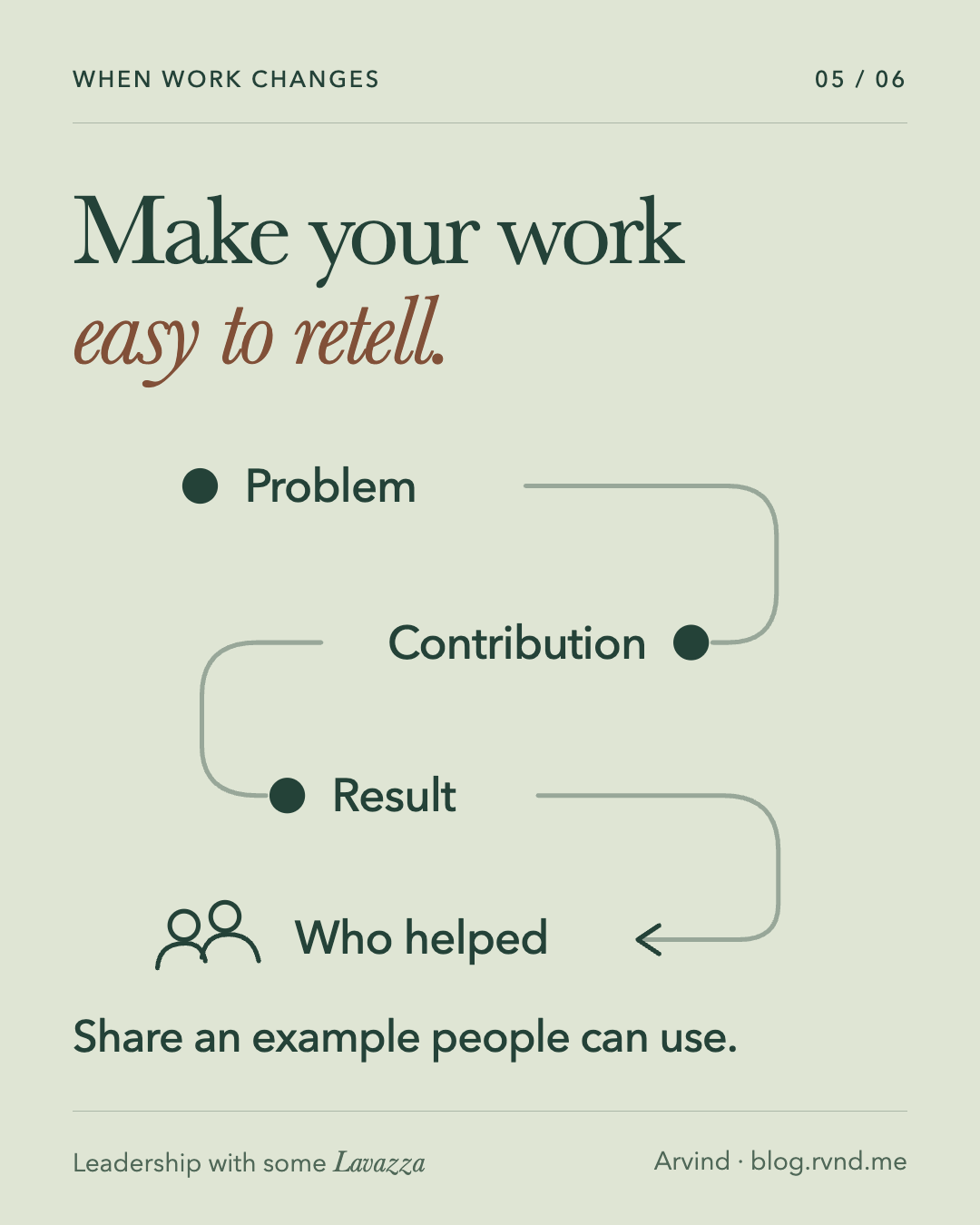
The problem → your contribution → the result → who helped.
Include work that rarely gets a launch announcement: keeping a service running, reducing rework, or helping two teams agree on a plan. Save an example that shows the difference. If you claim savings, be ready to explain the calculation.
A mentor who knows your work can help you spot contributions you take for granted. Share an example and ask: “Is the value clear to someone outside my team? What am I leaving out?”
Bring it into your next team update or conversation with your manager:
I worked with the support leads on a troubleshooting guide and clearer alerts. They can now handle cases that previously needed engineering. We're checking over the next month whether the new process keeps working.
Your manager has something specific to share when you aren't in the room. If you lead a team, do the same for people whose work might otherwise go unnoticed.
Publicly, and in your personal circles
Share something another person can use:
- A short explanation of how you solved a problem.
- A small demo of something you've learned.
- A decision you reconsidered, and what changed your mind.
- An answer in a professional community.
Use examples you're free to discuss. They give people a way to see how you think.
Keep in touch beyond your immediate team, too. A large LinkedIn study found that looser connections could help people find new jobs, particularly in digital industries.
When you catch up, share what you're learning and the problems you'd like to take on. Ask about their work as well. You may spot a way to help, and you've given them something specific to remember you for.
6. Find mentors, and make room for the relationship
You may already know someone whose questions help you think more clearly. A former manager, a colleague in another team, or a person you know through a professional community could become a mentor.
You can also seek different people for different needs. Someone who understands your organisation may help you prepare a priorities conversation; someone outside it may bring a useful view of your career options.
The National Academies' review of mentoring in science, engineering, and medicine emphasises trust, clear expectations, and relationships that adapt as needs change. Its setting is education and training; the following are ways to apply those principles to working life.
Start with one specific request
Look for relevant experience, someone who listens, and room for honest disagreement. If nobody comes to mind, try your employer's mentoring programme, an alumni network, or a professional association.
Make the first request easy to answer:
I'm considering a move from engineering into product. You've made that transition. Would you have 20 minutes to help me think through a small project I could try first?
Give them room to decline. If the conversation helps, ask whether they'd be open to another one after you've tried something.
Keep the relationship useful for both of you
- Agree on what works. Discuss what you'd like help with, how often to meet, and what should stay private. A short monthly conversation might suit you both; ask rather than assume.
- Come back with an update. Explain what you tried, what happened, and your next question. If you chose a different path from their advice, say why.
- Show interest in their world. Ask about their work, thank them specifically, and share something useful when you can. You don't have to repay every conversation with a favour.
- Revisit the arrangement. Needs and availability change. Adjust the rhythm or pause with appreciation if it no longer fits.
A mentor can challenge your thinking and support you through a difficult decision. You still get to make it.
A small exercise for your next coffee
Bring one concern and a blank page. Write down:
- One fact to check. What information would change your next decision?
- One action to schedule. An experiment, a priorities conversation, or a step towards another role.
- One contribution to share. Who would benefit from understanding what you did?
- One person to ask. Which mentor or potential mentor could help, and what specific question will you bring?
You may finish the coffee unsure about the next reorganisation or where AI will take your profession. But you will have chosen a next step, and someone to ask for another perspective while the answers take shape.