Imagine a product lead preparing a weekly customer update. The job is to summarize feedback and recommend what the team should address next.
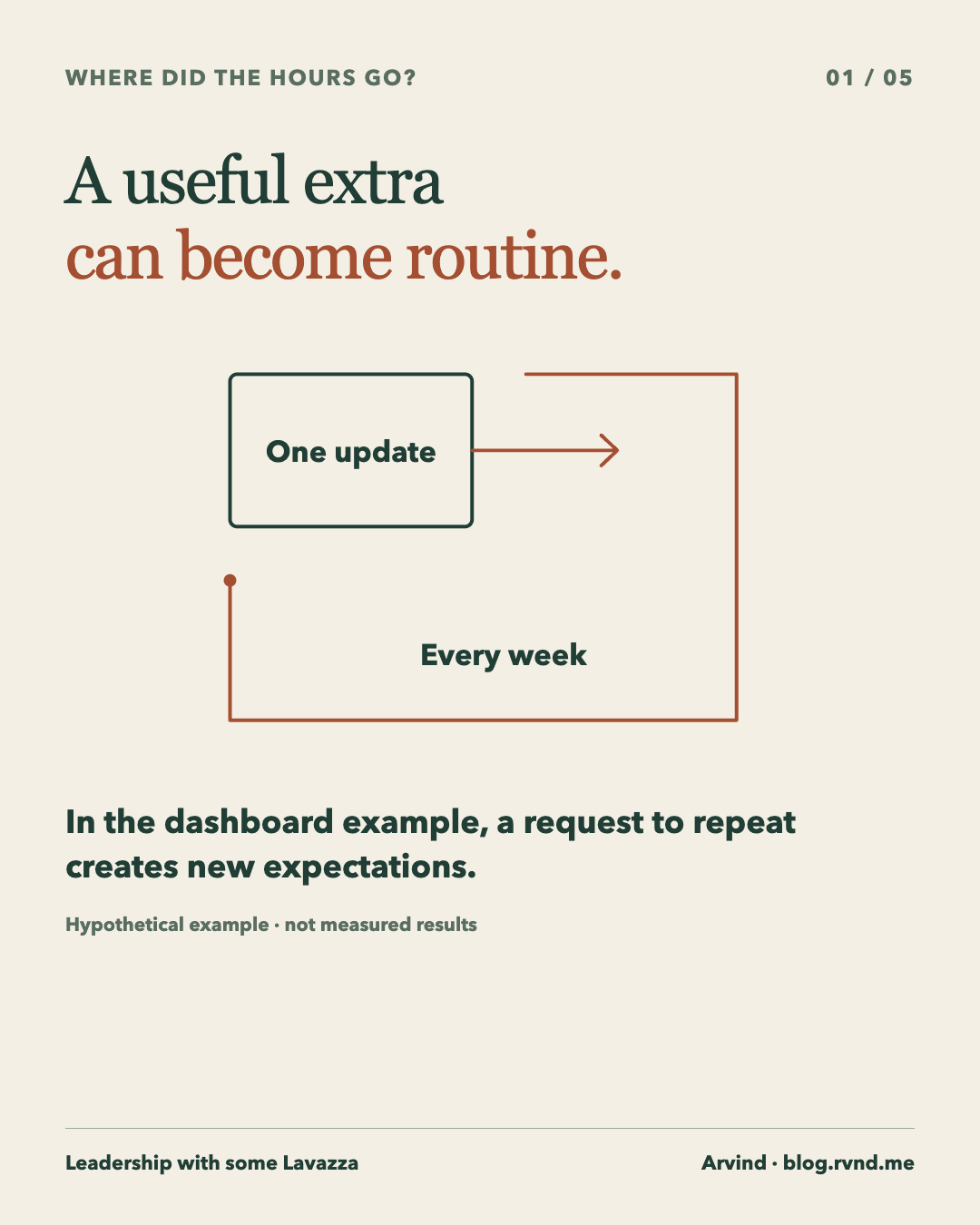
AI gets the first pass done earlier. So now there is spare time to compare two customer groups. That comparison now raises a new question, so the lead tries another cut of the data. A lead realizes a small dashboard makes the difference easier to explain in the meeting.
Next day, the team finds it useful. Someone asks whether it could include a third group next week.
Nothing obviously went wrong in this sequence. The analysis improved. Colleagues learned something new. An idea that might previously have stayed in a notebook became something people could use.
But next week's update now has a dashboard expectation attached to it.
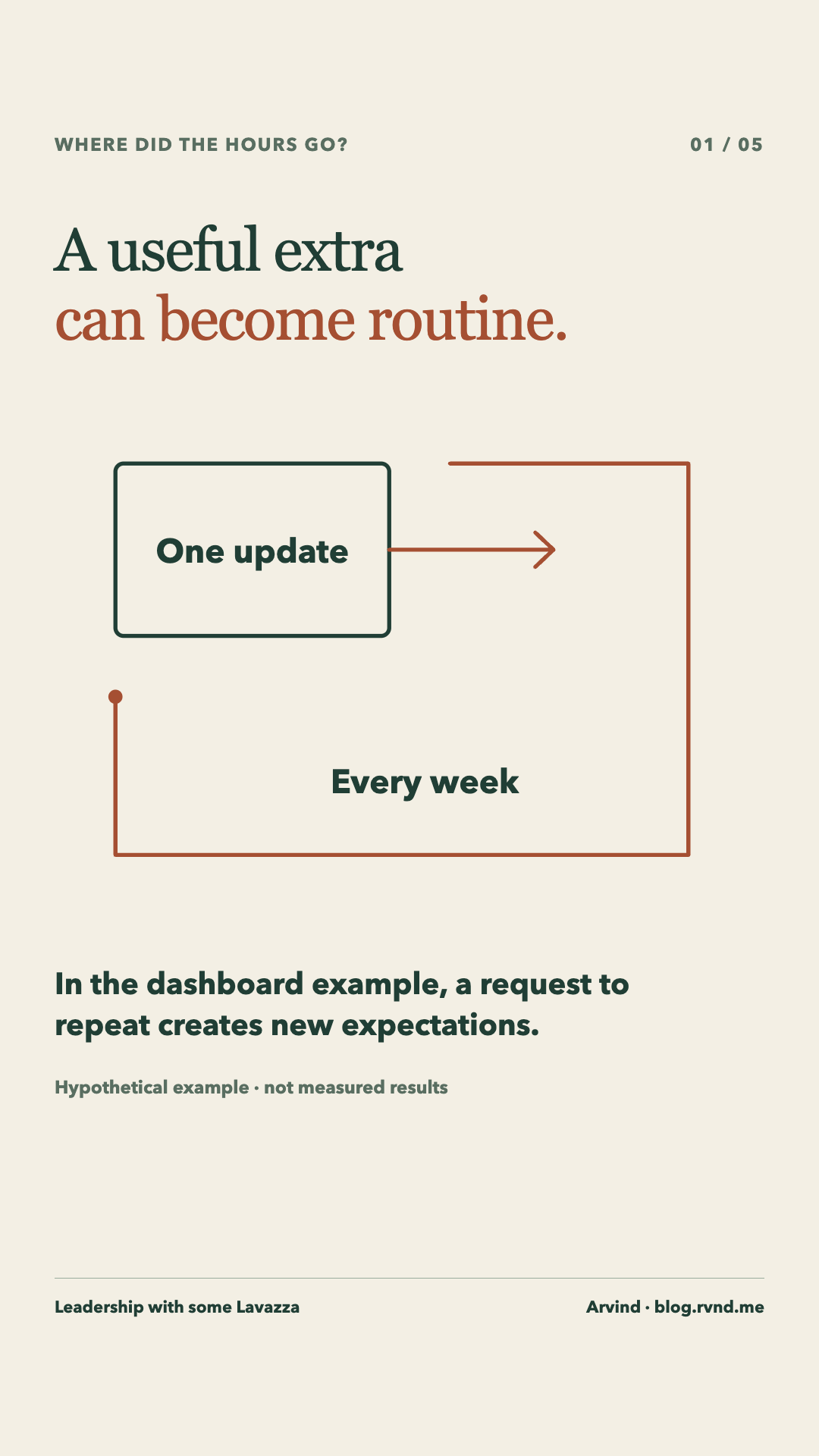
The extra work entered through curiosity and usefulness. Nobody had to announce a higher target. A request to see it again was enough to start changing what the weekly update included.
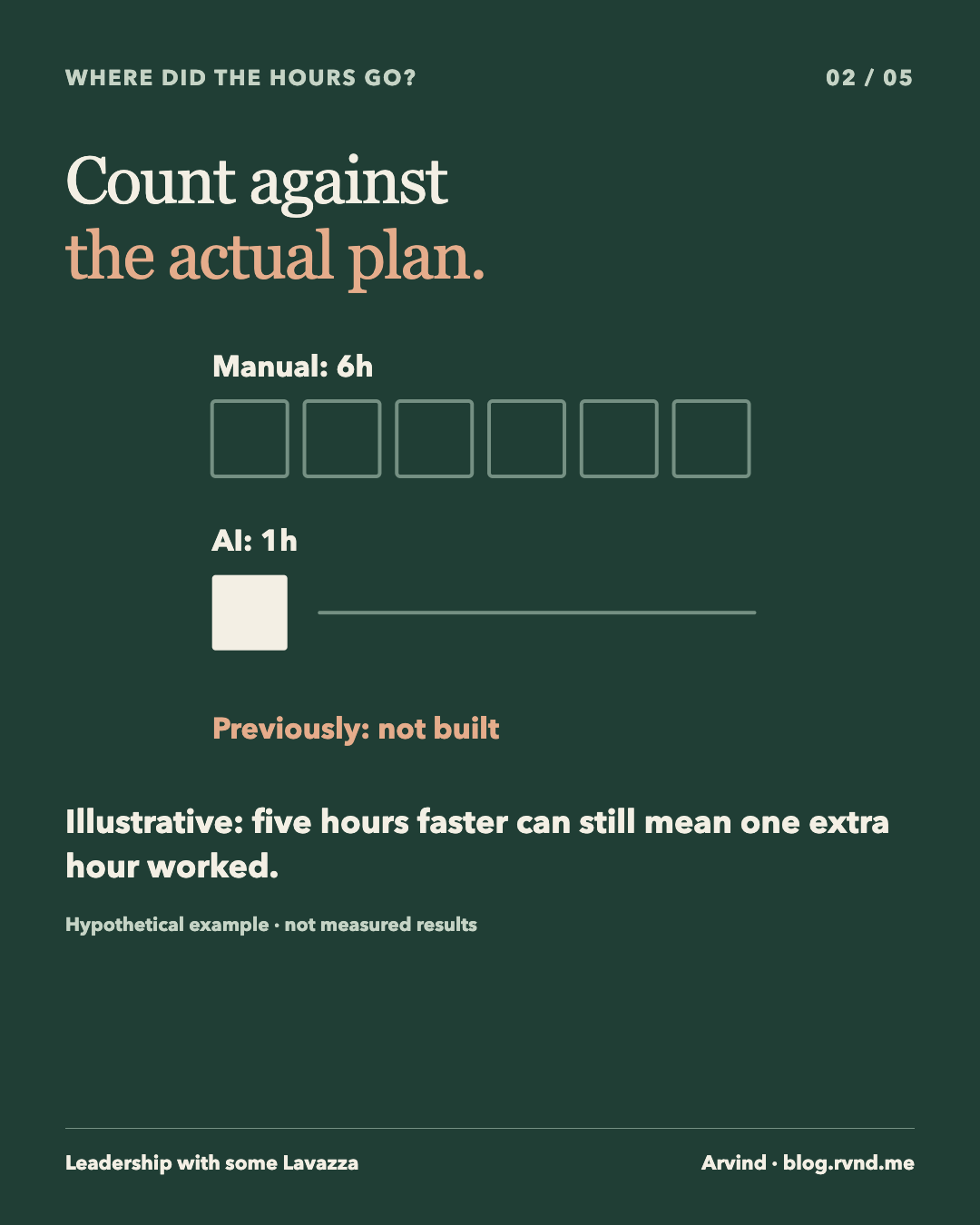
Five hours saved. One hour added.
Work that would previously have gone undone also appears in Anthropic's internal research. Its engineers and researchers estimated that 27% of their Claude-assisted work would not have been done without it. Examples included exploratory work, internal tools and interactive dashboards. The study surveyed 132 people and included 53 interviews. That is a self-reported estimate from an AI company, and the denominator is assisted work, not the whole working week.
Now suppose our product lead's dashboard would have taken six hours to build manually. It was never going to justify that effort. With AI, it takes one.
| Compare the dashboard with… | What changed? |
|---|---|
| Building it manually in six hours | Five hours less effort |
| The previous plan, which had no dashboard | One additional hour of work |
Both comparisons are valid. Only the second tells us what happened to the person's week.
Calling the dashboard “five hours saved” invites someone to look for five spare hours that were never in the calendar. The actual gain is a dashboard worth building at a cost of one hour. If it helps the team make a better decision, that may be an excellent return.
The one-hour build is only the beginning. The request to see the dashboard again brings a different kind of cost.
When “useful” becomes “usual”
The dashboard now needs a refresh. A data field changes. Someone asks why last week's numbers differ and proposes an FAQ section. Life happens, and the original author is away when a colleague needs to generate it.
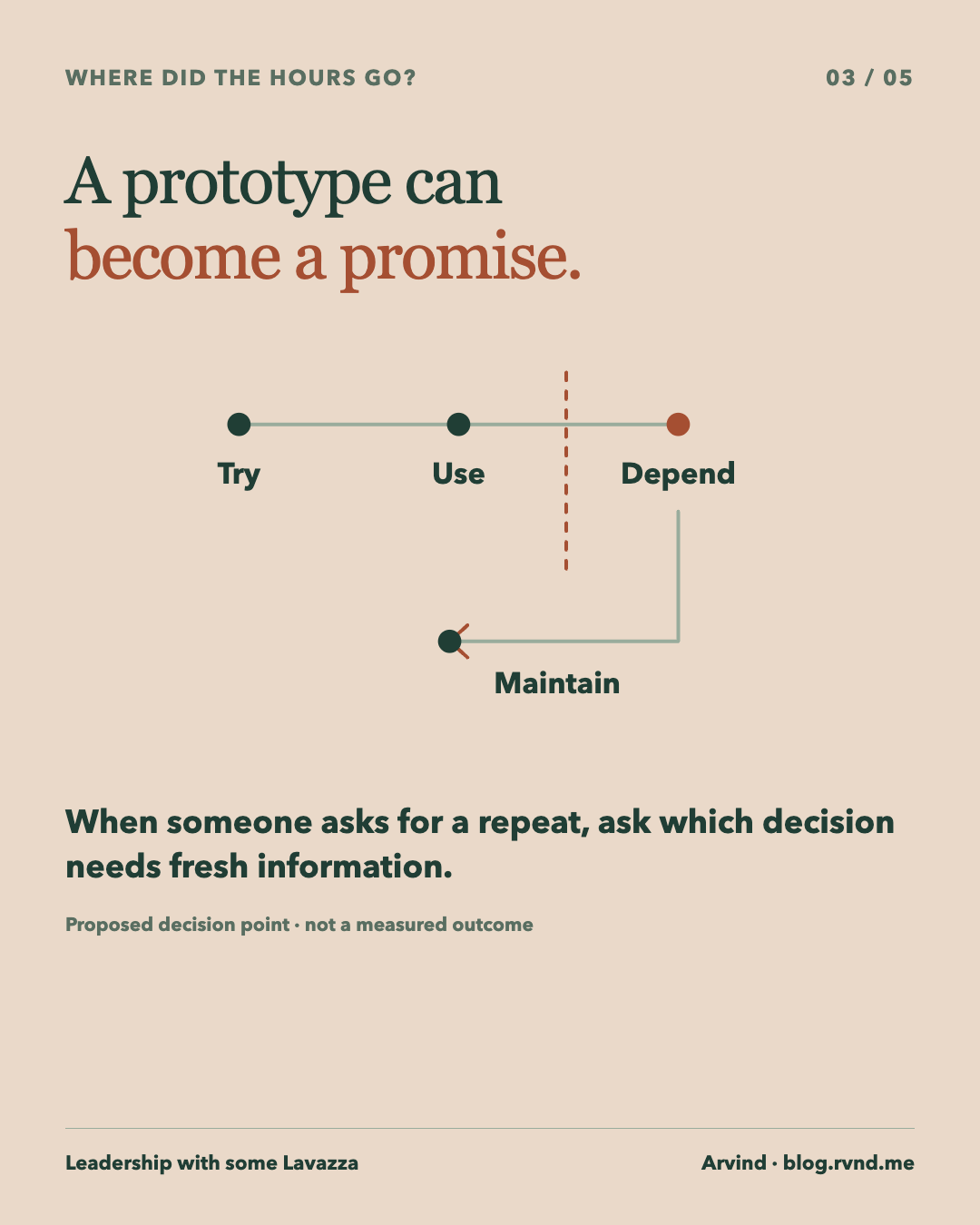
AI may help with all of this. But the team now expects an answer when the dashboard breaks, and fresh numbers when the meeting begins. The first version's usefulness has become a claim on future time.
AI can lower the cost of starting something before it lowers the cost of owning it.
This is where an organization could become busier without making a single large decision to take on more work. A report here, a small internal tool there, each cheap enough to try, and helpful enough to keep. The person who built each one may become its maintainer simply because everyone knows whom to ask.
There is a temptation to require more approval before anyone builds anything. That would make a one-hour experiment harder to justify, even though experimentation has become more affordable.
The request to repeat it is probably a better point to pause. At that moment, the team knows more about its value and is about to make a commitment. “Could we have this every week?” deserves an answer about what the fresh information will help someone decide, and how often that decision actually occurs.
A weekly meeting does not, by itself, make every analysis worth repeating weekly.
A quieter evening counts, too
There is another possible ending to the product lead's afternoon: the original update gets finished earlier, and less work follows them home.
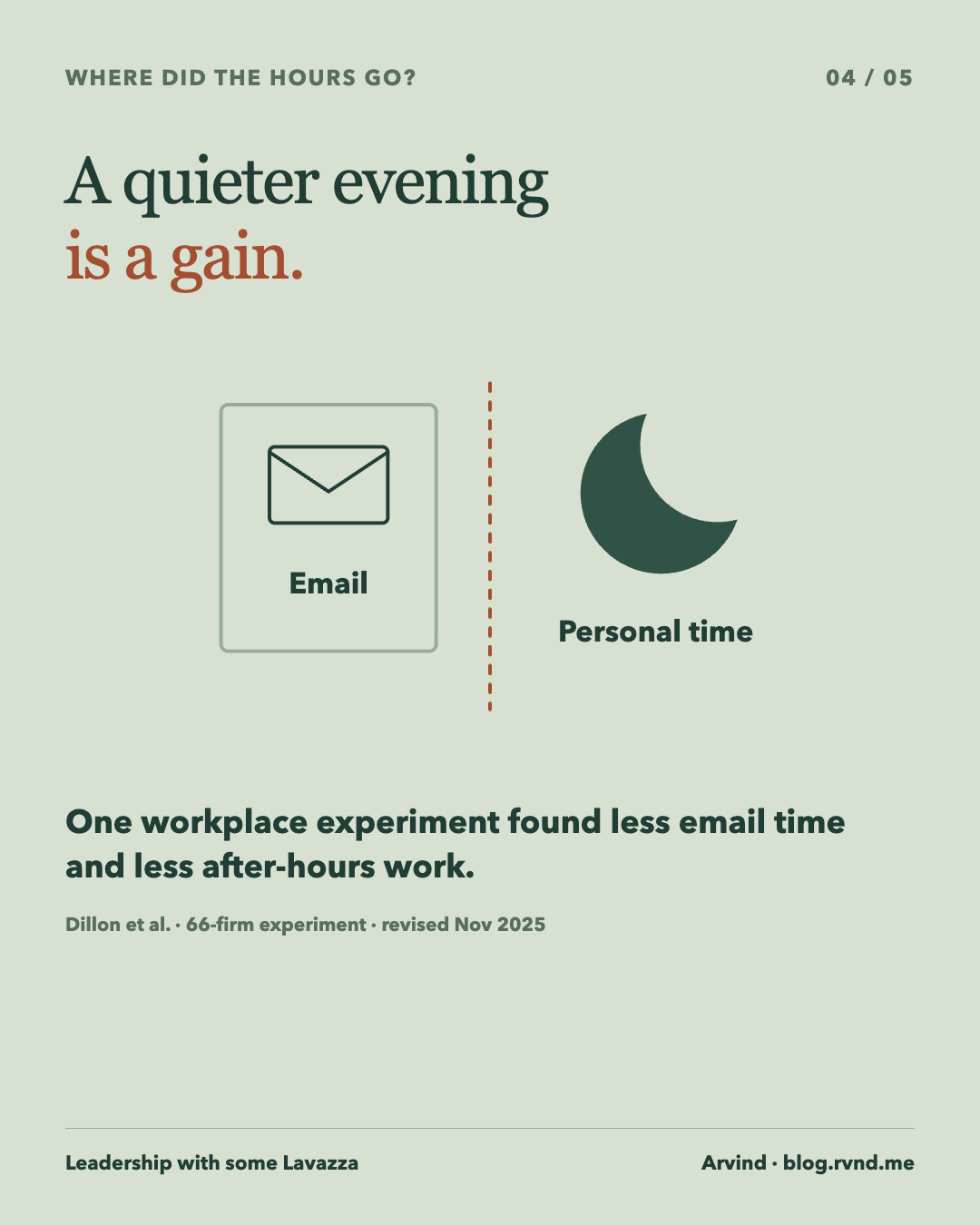
That possibility has research behind it. A randomized experiment across 66 firms and 7,137 knowledge workers found that, in the second half of the six-month study, tool users spent around two fewer hours a week on email and reduced work outside regular hours. The November 2025 revised abstract reports no detected change in task quantity or composition from individual access to AI.
A tally of additional output would miss part of that gain. For someone whose email spills into the evening, getting it done within the day is a result worth keeping.
The dashboard is more visible. It can be shown in a meeting and credited to AI. An evening without email produces no new artifact to demonstrate. If leaders ask only what extra work the tool enabled, they risk overlooking the time it actually returned.
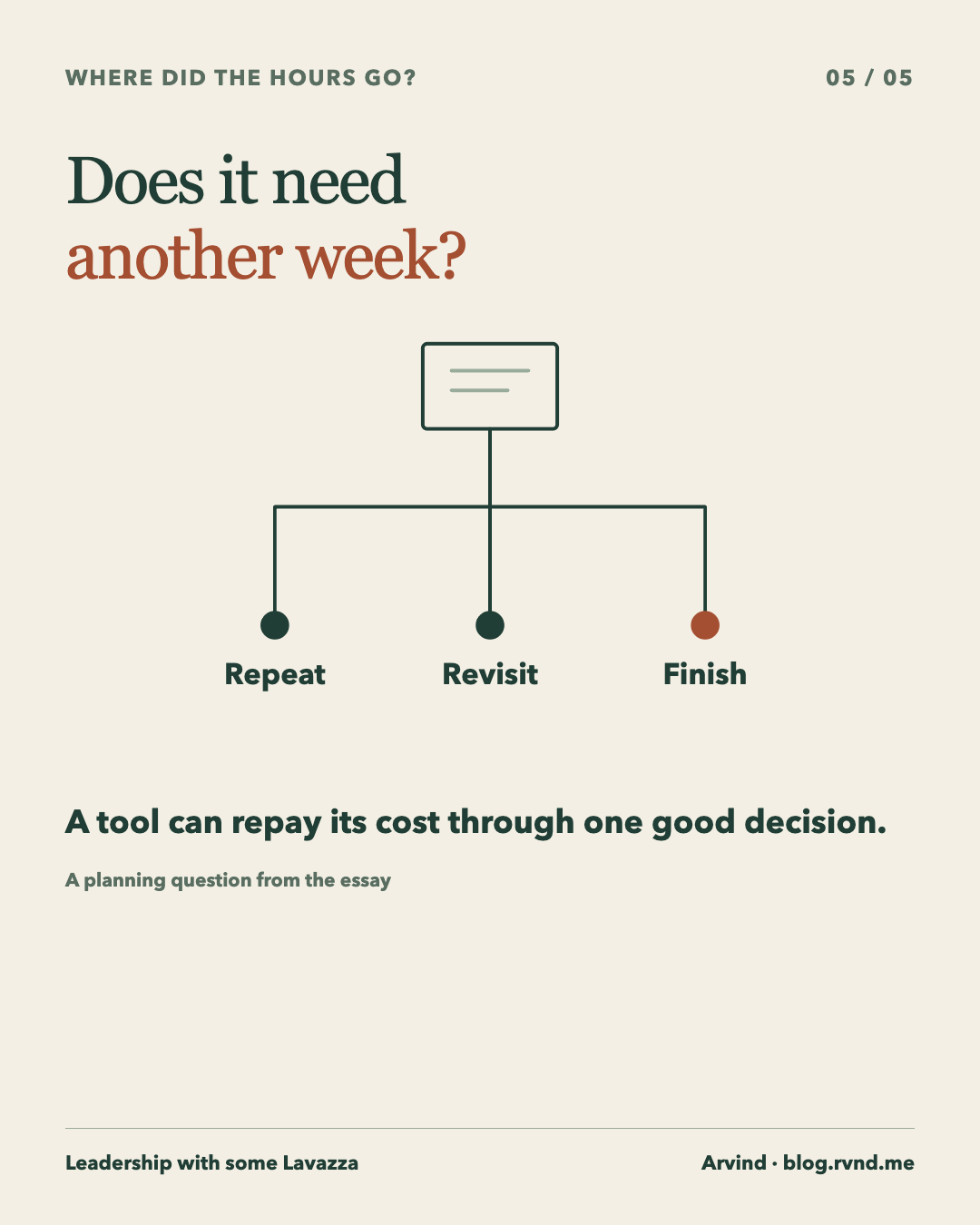
Does the dashboard need another week?
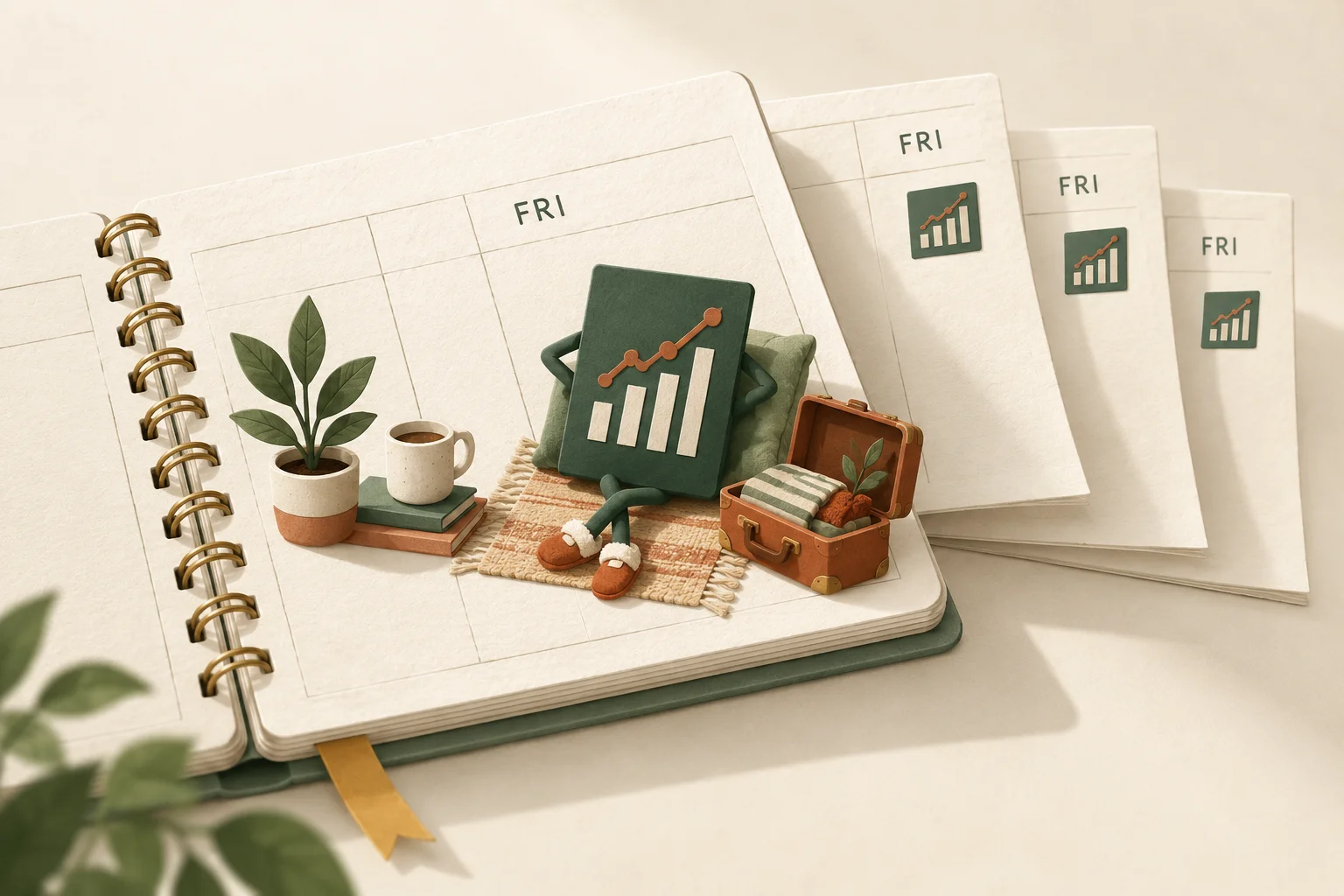
“Could you add one more customer group?” can quietly become “Could you do this every Friday?” The extra comparison can be worth doing without making the dashboard a permanent part of the weekly update. Before that becomes the default, the team needs to say what it expects to learn from each new version.
If fresh feedback could change which customer problems the team prioritizes, regular updates have a purpose. If the comparison has answered the question that prompted it, the team can keep the finding and return to the dashboard when another question arises. The choice of when to refresh it should follow how the information will be used.
For a recurring dashboard, give the work time in the plan and an owner who has agreed to it. The ease of building the first version cannot tell us whether each fresh analysis earns the effort of producing it.
The curiosity that produced the dashboard was worth acting on. Letting the experiment finish preserves that value without committing the team to a weekly refresh. A tool can repay the hour spent on it through one good decision.
Where did the hours saved by AI go? In this example, five of them existed only in a comparison with work that would never have happened. One real hour bought a useful analysis. Future hours became a question when someone asked to see it again.
The dashboard earned its first afternoon. Whether it belongs in every Friday after that is still a decision the team gets to make.