Meanwhile, Under the Table
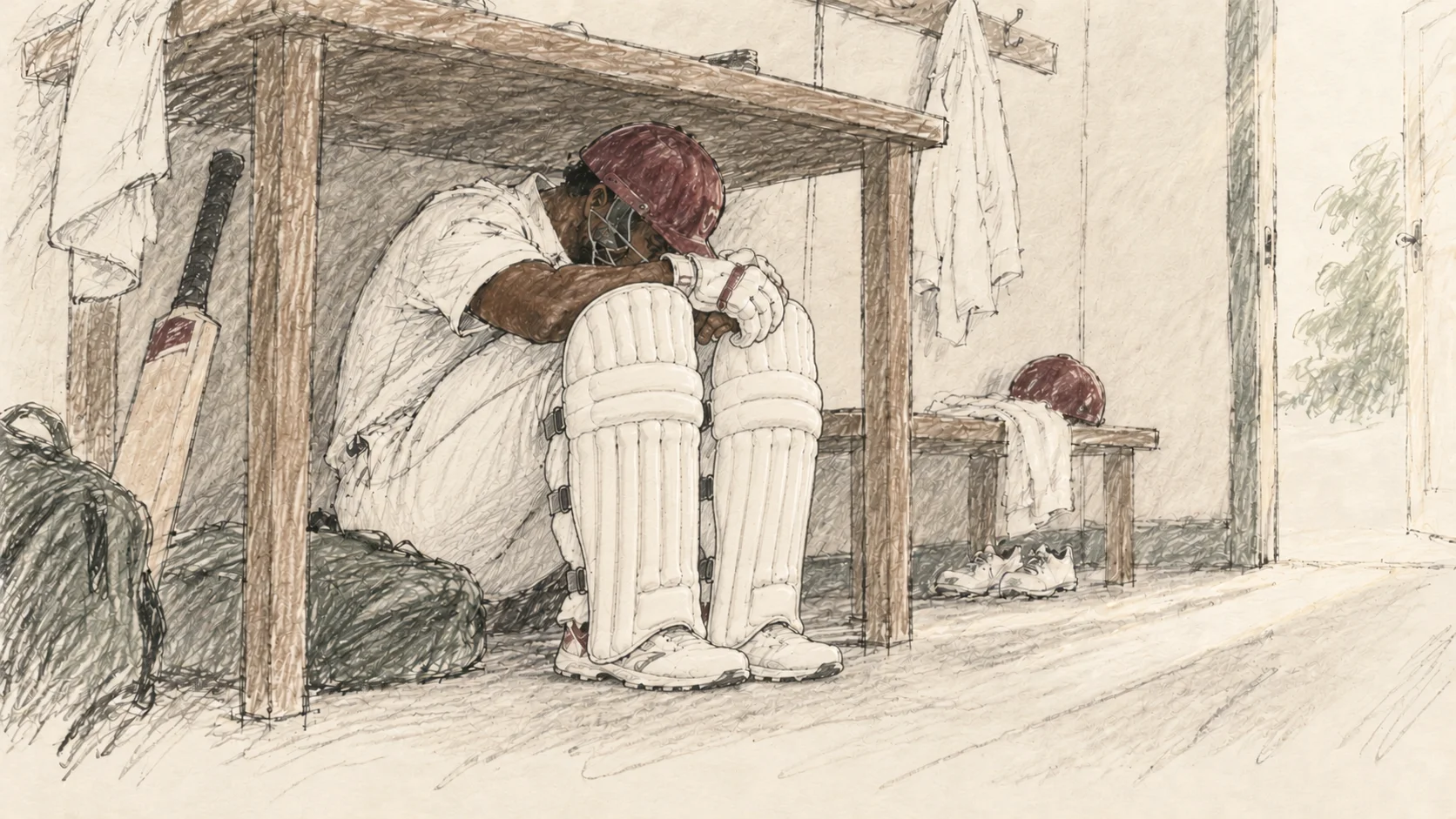
Nehemiah Perry is under a table.
Helmet on. Gloves on. Pads on.
Outside, Brian Lara is trying to win a Test match. Inside, a man who has just been dismissed first ball has decided he cannot watch any more of it.
Perry recalls this scene years later. He keeps his equipment on, stays where he is, and lets the noise from the crowd tell him what is happening.
I rather like this detail.
Great sporting moments tend to arrive in our memories with everybody looking suitably heroic. There is the winning shot. There are the raised arms. Someone finds a photograph that makes the whole thing seem inevitable.
Meanwhile, one of the participants is hiding beneath the furniture.
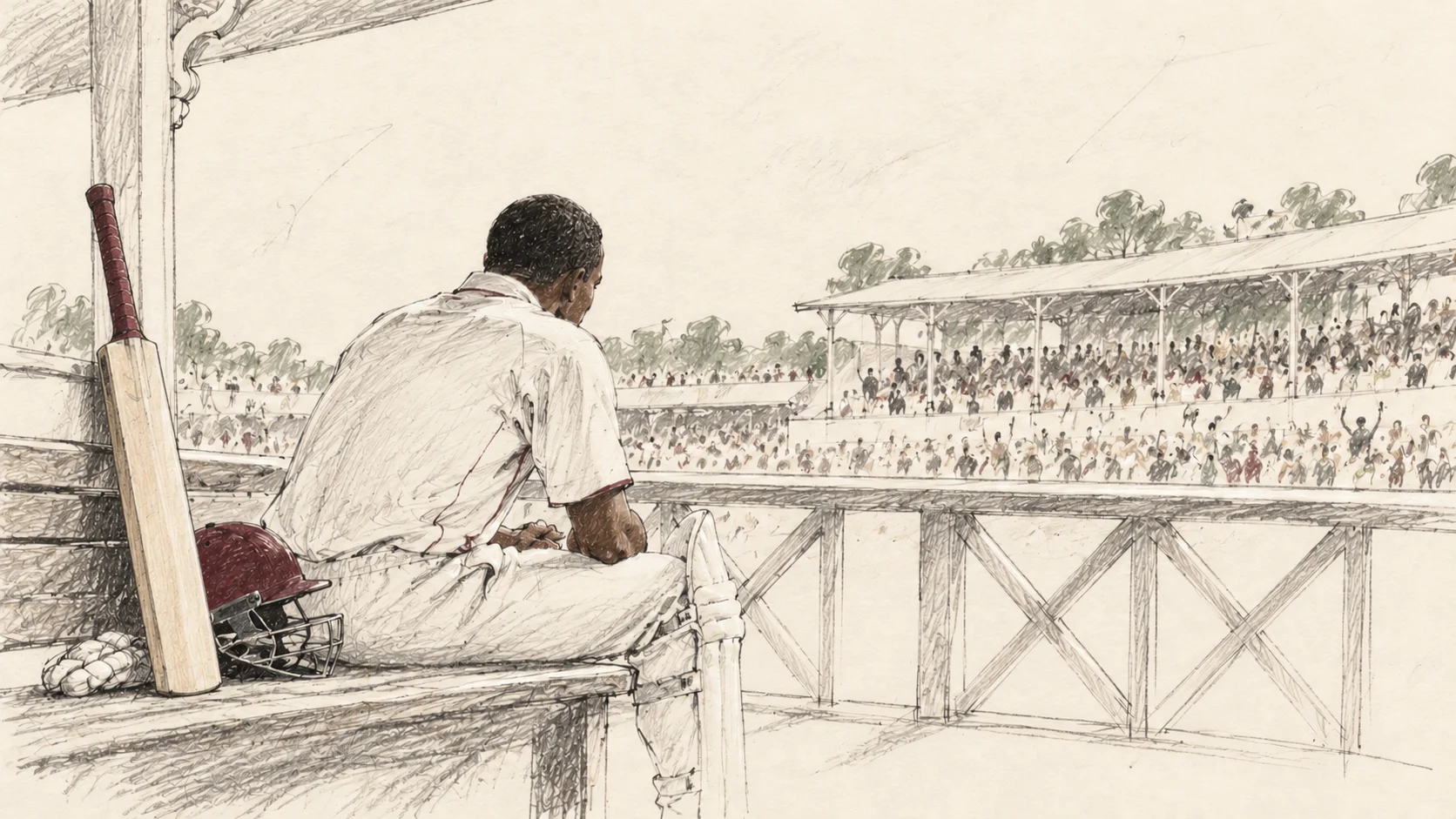
That feels considerably closer to the experience of following Test cricket. You have invested several days in a contest whose next delivery can make all that investment feel like a terrible idea.
Perry has good reason to worry. West Indies need 60 when he gets out. Only Curtly Ambrose and Courtney Walsh remain to keep Lara company.
We will come back to the table.
First, we need to understand how a match gets to the point where a very tall fast bowler leaving a ball alone can bring a ground to its feet.
A Genius on Probation
The series begins with West Indian cricket in a rather unpleasant place.
South Africa have just beaten them 5–0. The West Indies board has retained Lara as captain for only the first two Tests against Australia, after which his position will be reviewed. The contemporary announcement makes the terms quite clear.
Probation.
For Brian Lara.
Imagine being told your performance will be assessed shortly, and then discovering that the assessment panel includes Glenn McGrath and Shane Warne.
The first Test offers no relief. West Indies are bowled out for 51 in Port of Spain. Five consecutive Test defeats in South Africa become six consecutive defeats overall. The captain is running out of room, and the people watching are running out of reassurance.
There is a larger history sitting behind this. Australia took the Frank Worrell Trophy in the Caribbean in 1995. The West Indies side that once made opponents feel they were entering a prolonged argument with four fast bowlers is losing its authority.
Lara has the talent to remind people of what remains possible. Talent, however, is an awkward answer to a whole team’s problems.
Then comes Jamaica.
At Sabina Park, Lara makes 213. Jimmy Adams stays with him for 94. Their partnership is worth 322, and West Indies win by ten wickets.
Suddenly, the series is level.
The same captain who has been publicly put on notice has given his team a reason to believe again. That changes the emotional weight of Bridgetown. The third Test becomes a chance to show that Jamaica can be followed by something more substantial than a pleasant memory.
Australia have their own captain settling into the job. Steve Waugh has taken over from Mark Taylor, and he is hardly inclined to supervise somebody else’s recovery.
Both teams arrive with unfinished business.
One of them is about to bat for most of two days.
The Shoe Gives Up. Waugh Doesn’t.
Australia win the toss and bat.
Before the opening spell has properly finished doing its damage, Ambrose’s shoe splits. He cannot complete his fifth over; Pedro Collins finishes it for him. This small equipment failure earns its own entry in the archived match notes.
Test cricket asks a great deal of the body. Occasionally, the footwear registers its objection first.
Ambrose returns. Walsh removes Matthew Elliott. Ambrose gets Michael Slater and Mark Waugh in the space of three balls.
Australia are 36 for three.
This looks promising. The West Indian fast bowlers have the ball moving, the crowd has something to work with, and Steve Waugh has to begin against an attack that is already enjoying itself.
Waugh stays.
He stays through the dangerous deliveries. He stays while Justin Langer helps the score recover. When Langer goes for 51, with Australia at 144 for four, Ricky Ponting joins him.
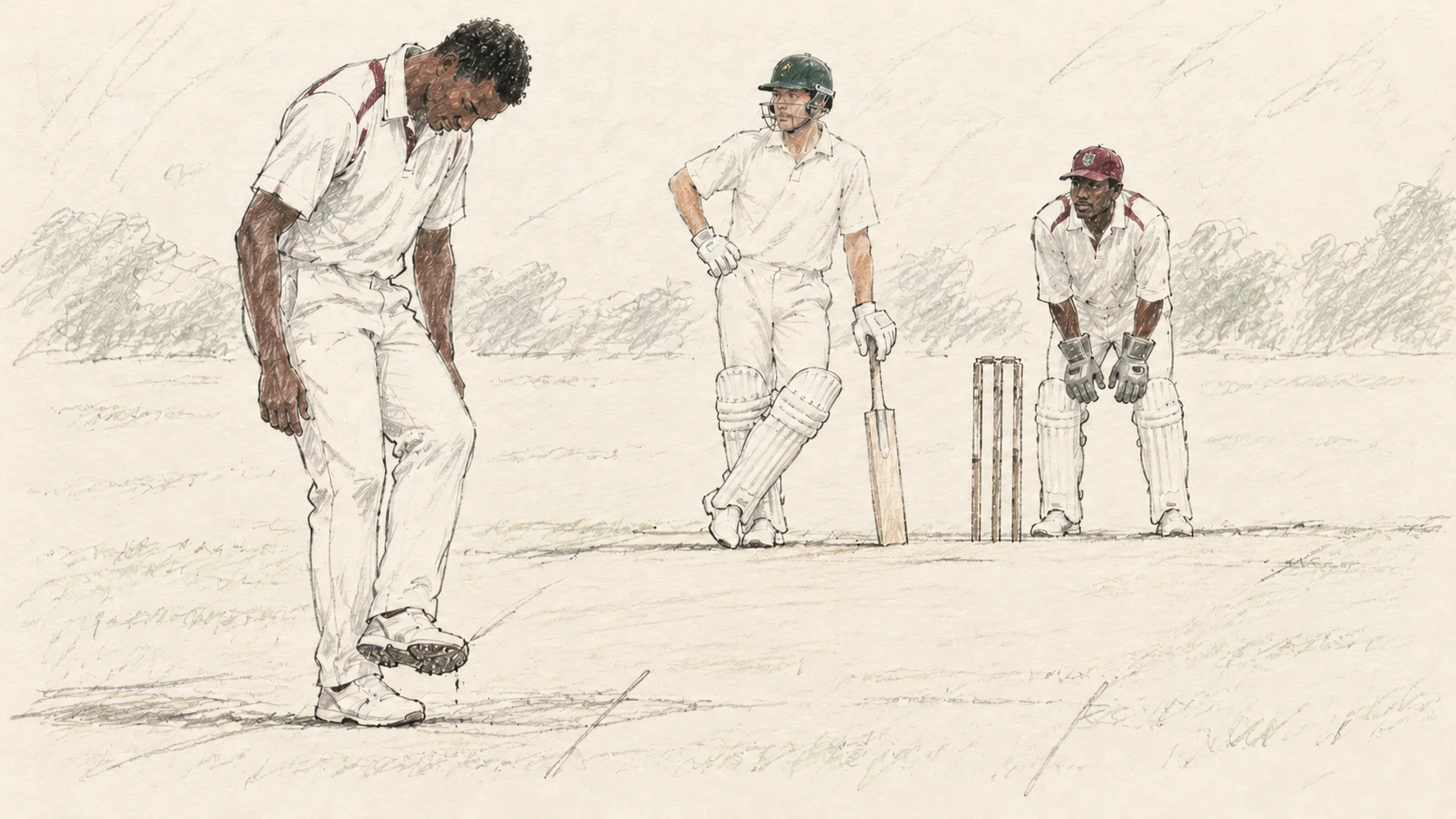
Ponting has his own opportunity to protect. Greg Blewett’s injured thumb has opened a place in the side. A young batter with an enormous reputation still has to produce the innings that makes a selector reluctant to leave him out.
He begins the practical part of that argument.
The partnership grows. The ball gets older. Ambrose and Walsh have to rest. The same field that looks crowded while wickets are falling begins to offer gaps once two batters have settled.
By stumps, Australia are 322 for four. Waugh has 141. Ponting has 65.
That is a whole day’s change of mood: from the expectation of another wicket to the question of how much longer these two intend to stay.
For West Indies, the answer is going to be inconvenient.
490, and a Very Long Walk Back
Waugh and Ponting carry on into the second day. Their stand reaches 281.
Ponting makes 104. Waugh gets to 199 before Perry traps him lbw.
A hundred and ninety-nine is a magnificent contribution to a Test match. It is also the sort of score that gives an otherwise excellent afternoon one very specific annoyance.
Perry takes three wickets, including both century-makers. Remember that when we return to his hiding place. He has already done useful work before the day on which he wishes to disappear.
Australia finish with 490.
Now West Indies have to begin again, against McGrath and Jason Gillespie, with two leg-spinners available behind them.
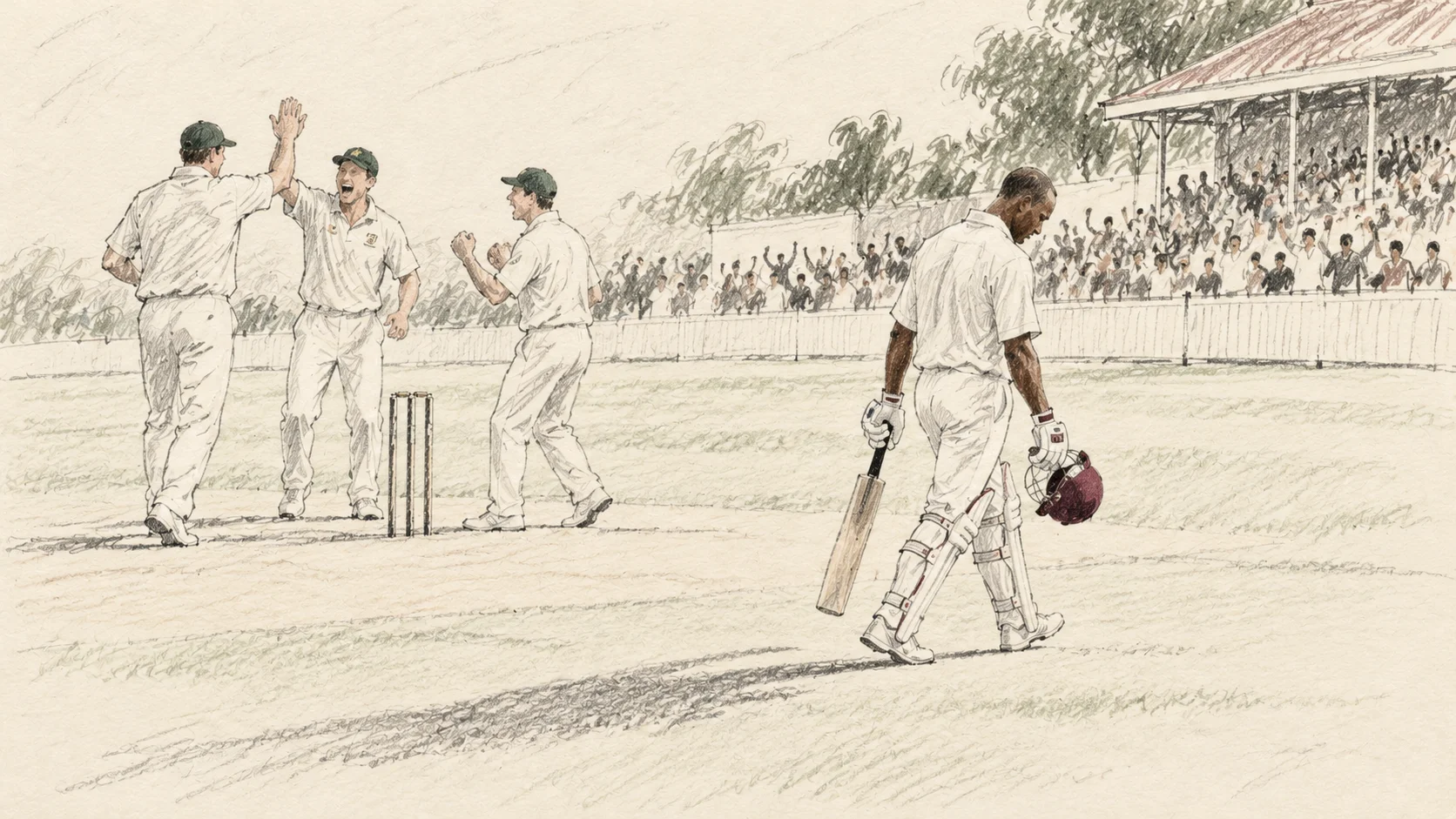
Adrian Griffith is run out in the first over. Dave Joseph goes. Collins, sent ahead of Lara as a nightwatchman, lasts one ball.
A nightwatchman is supposed to keep a specialist batter away from the awkward deliveries before stumps. It is a sensible idea that can become rather less sensible when the protection lasts approximately as long as the walk to the crease.
Lara comes in anyway.
And Lara goes for eight.
Gillespie finds the edge; Ian Healy takes the catch. West Indies are 64 for four. By the close, they have reached 80 for four, with Sherwin Campbell and Carl Hooper still there.
We know the famous number that will eventually sit beside Lara’s name. But here, on the second evening, his contribution is eight, his team is 410 behind, and Australia have every reason to expect to win.
Someone else has to keep this match available to him.
The Rescue Before the Rescue
The third morning initially makes things worse.
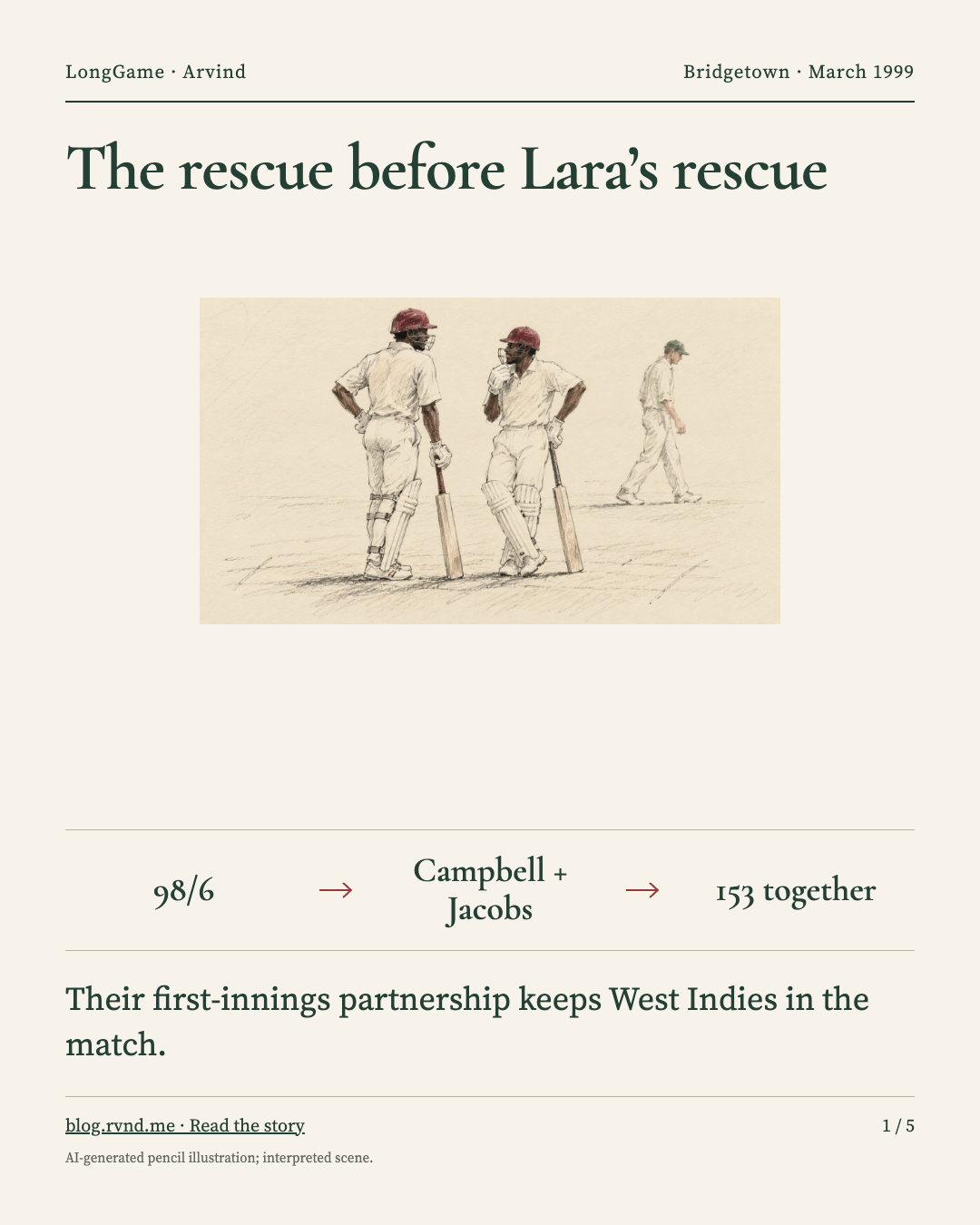
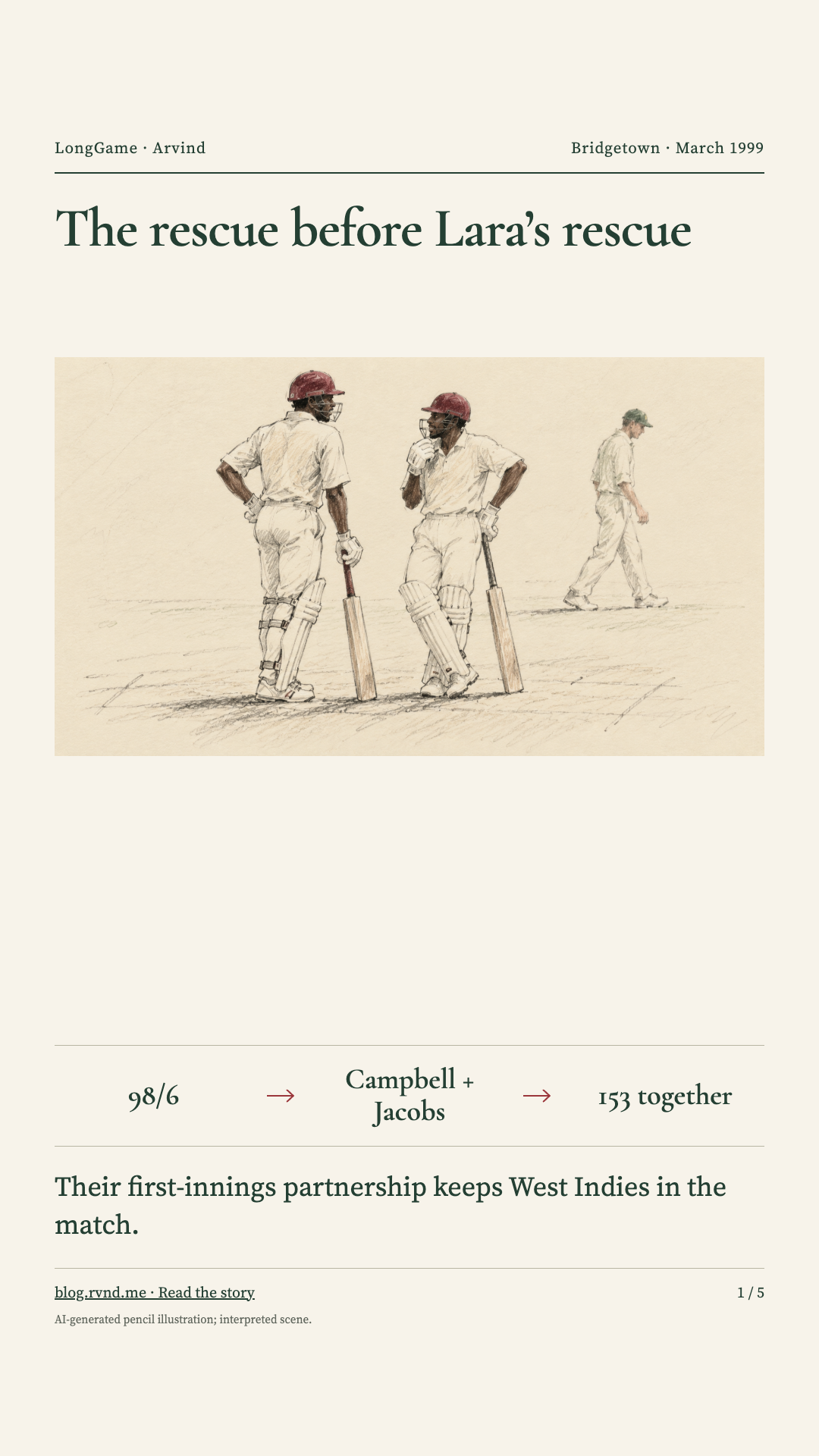
McGrath removes Hooper. Adams follows without scoring. At 98 for six, West Indies are still 392 runs behind.
The immediate question is whether they can get past 290 and remove Australia’s option of enforcing the follow-on. Winning belongs to a much more ambitious conversation.
Campbell is still there.
This is his home ground. It is also a fairly unforgiving place to be an opener who has watched five partners leave while Australia’s total remains enormous.
Ridley Jacobs joins him. They have to get through the good bowling before they can do much about the bad situation.
Gillespie is particularly difficult to score from. His first-innings figures will finish at three for 48 from 28 overs, fourteen of them maidens. A scoreboard can make that look pleasantly tidy. Standing at the other end of it must be considerably less pleasant.
Campbell and Jacobs get West Indies to lunch at 151 for six.
They are still in trouble. They are also still batting.
After lunch, the boundaries begin to come. Campbell cuts and drives. Jacobs finds runs against the spinners. In the first five overs after the interval, the pair add 34.
There is a practical change underneath the change in mood. McGrath and Gillespie cannot bowl indefinitely. Warne is returning from shoulder surgery and is struggling for his usual control. The batters have earned the chance to face a different problem.
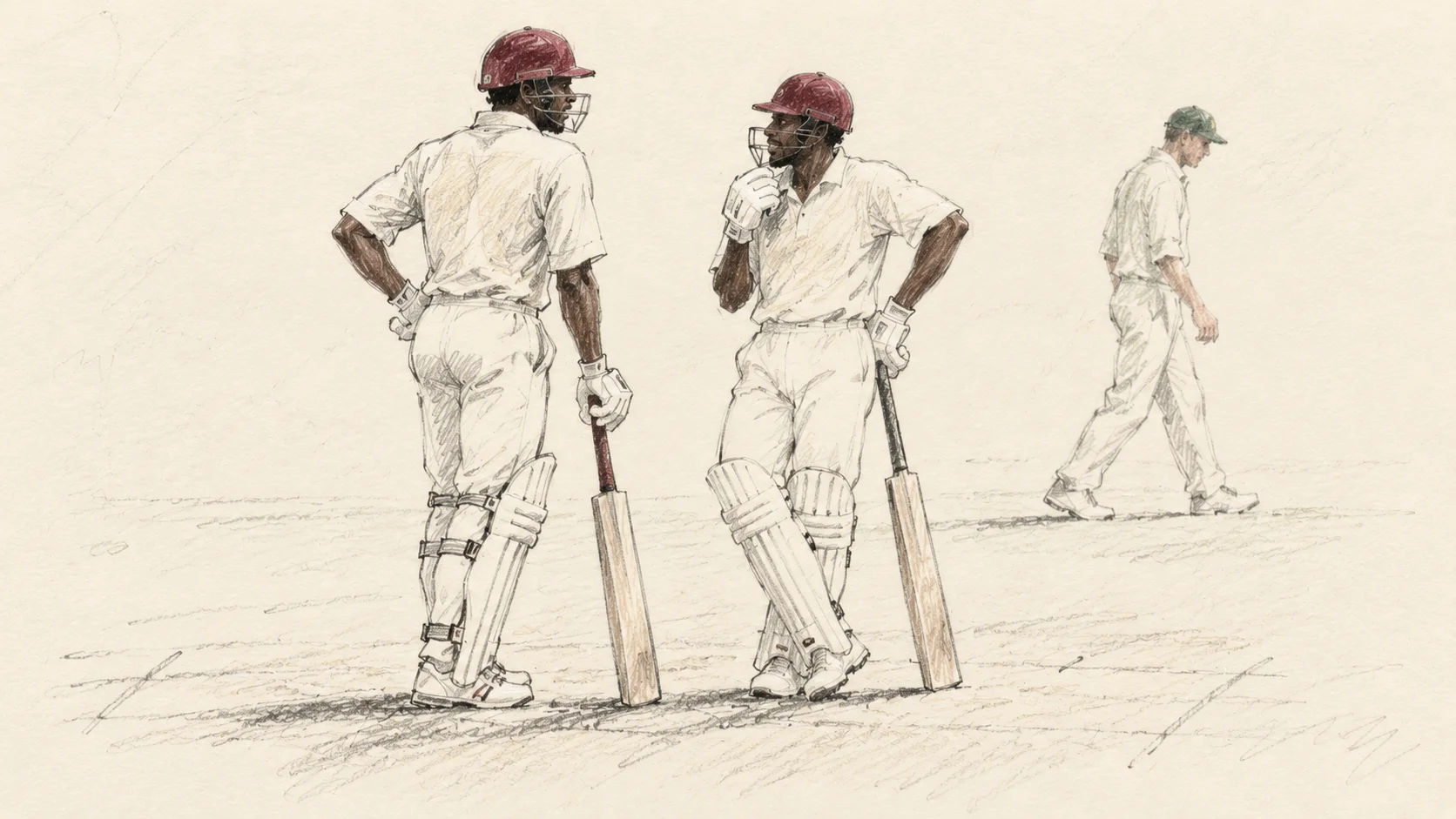
That is one of the pleasures of the long game. Surviving a spell can improve the conditions of your next hour. A stretch of defensive batting can buy the freedom that comes later.
Campbell reaches his hundred. Jacobs makes 68. Their partnership is worth 153, lifting the score from 98 for six to 251 for seven.
For once, 153 belongs to two other people.
Even then, the job is unfinished. Campbell falls for 105 at 265 for eight, still short of the follow-on threshold. Perry contributes 24. Ambrose makes 28 not out. Walsh adds 12.
West Indies reach 329. Australia’s lead is 161.
Those runs from the bowlers are easy to skim past. A few days later, twelve from Ambrose and no runs at all from Walsh will demand everyone’s attention. Here, their batting has already helped secure a second innings for Australia instead of an immediate return to the crease for West Indies.
The match is still badly tilted.
But the West Indian bowlers have something to bowl at.
Walsh Reopens the Match
Elliott is out to the second ball of Australia’s second innings. Langer follows. Australia close the third day at 18 for two.
Now comes the part that gets squeezed when the whole Test is reduced to Lara’s last afternoon.
Walsh, Ambrose and Collins dismantle Australia’s second innings.
Campbell helps start the fourth morning’s damage with a throw that runs Slater out. Ambrose bowls Gillespie, Australia’s nightwatchman. Walsh traps Mark Waugh. Collins gets Steve Waugh and Healy.
At 81 for seven, Australia’s first-innings advantage is doing rather more work than their current batting.
Warne resists with 32, the highest score of the innings. Ponting stays for 22. Their stand adds 53, a reminder that Australia’s lower order can also make a target less inviting. Even McGrath contributes two boundaries.
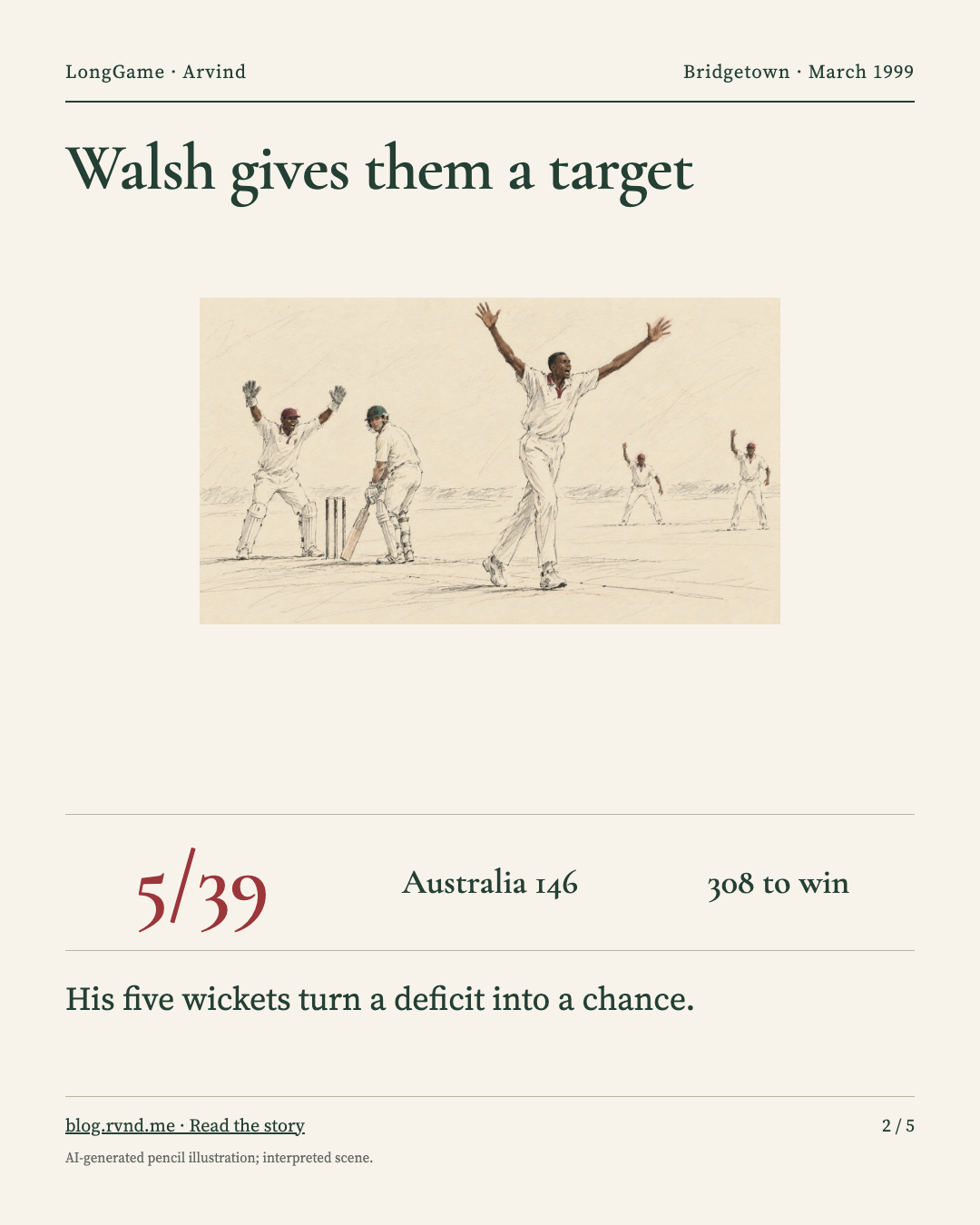
Walsh finishes the innings with five for 39. Ambrose and Collins have two wickets each.
Australia are all out for 146.
The scorecard now presents West Indies with a target of 308.
It is a demanding chase. It is also a chase. A day earlier, getting the game into this condition would have sounded wildly optimistic.
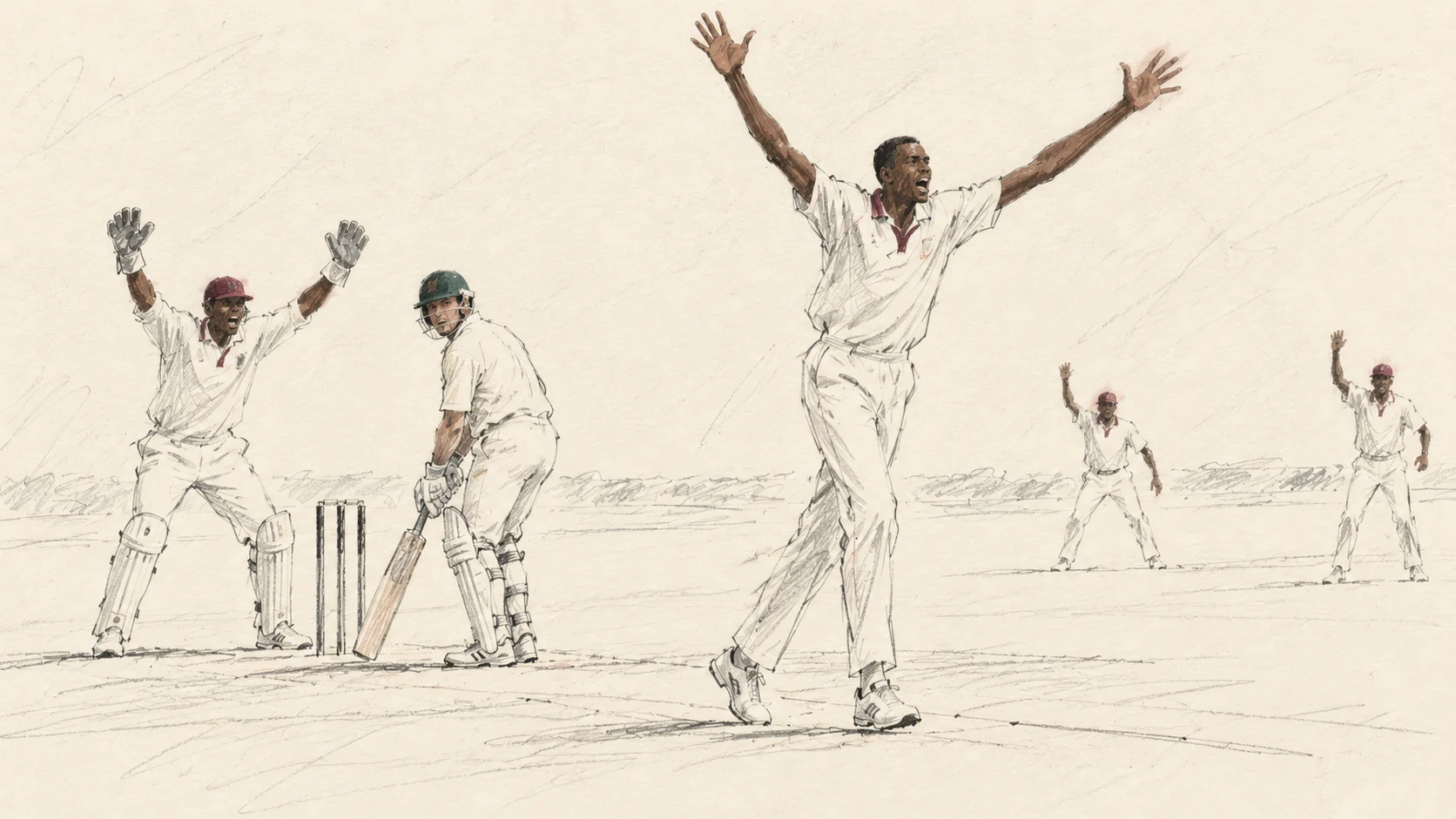
I like that the door is reopened by the people who will later have to stand beside Lara with a bat. Walsh has earned the opportunity he is eventually asked to protect. Ambrose’s contribution has been accumulating for days.
Campbell and Griffith begin well, putting on 72.
Then McGrath removes Campbell. Joseph falls to MacGill. Collins is sent in as nightwatchman again and is dismissed without scoring again.
The position appears to be a recurring vacancy.
By stumps, West Indies are 85 for three. Griffith has 35. Lara has two.
Griffith has spent more than three hours keeping one end occupied. Lara is there for the morning.
Australia need seven wickets.
West Indies need 223 runs.
There is a full day to do something about it.
The monthly cricket journal
LongGame, in your inbox.
One story. Every month.
Subscribe directly on Substack
This subscribes you to LongGame only. How your email is used.
Stay for the next Test. Subscribe to LongGame for one cricket story every month.
Lara Finds Another Gear
Gillespie gets Griffith without an addition to his overnight score. Hooper follows for six.
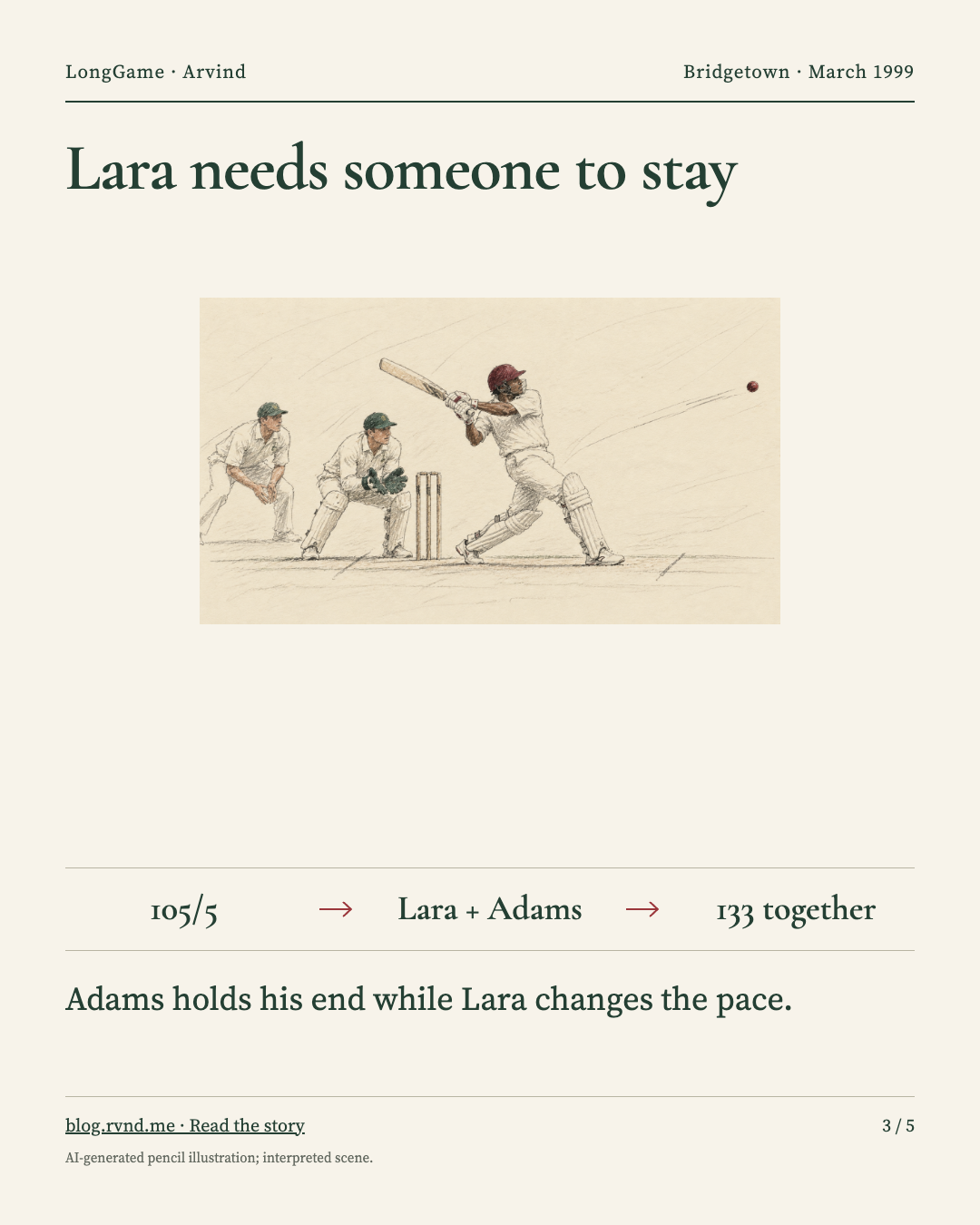
West Indies are 105 for five. There are still 203 runs to find.
Adams joins Lara.
This partnership takes a while to look comfortable. Adams has to work through deliveries that beat him, crowd him or refuse to arrive where he expects. Lara has his own careful beginning against the fast bowlers.
The attractive cricket has to wait its turn.
At lunch, West Indies are 161 for five. Lara has 44; Adams has 20. The target is 147 away.
Australia’s attack has begun to feel the consequences of its shape. They have selected two fast bowlers and two leg-spinners. Gillespie’s back is causing trouble. McGrath can keep returning, but even he has to breathe between spells.
Waugh uses his own bowling. The leg-spinners remain in the contest. Lara begins to make them expensive.
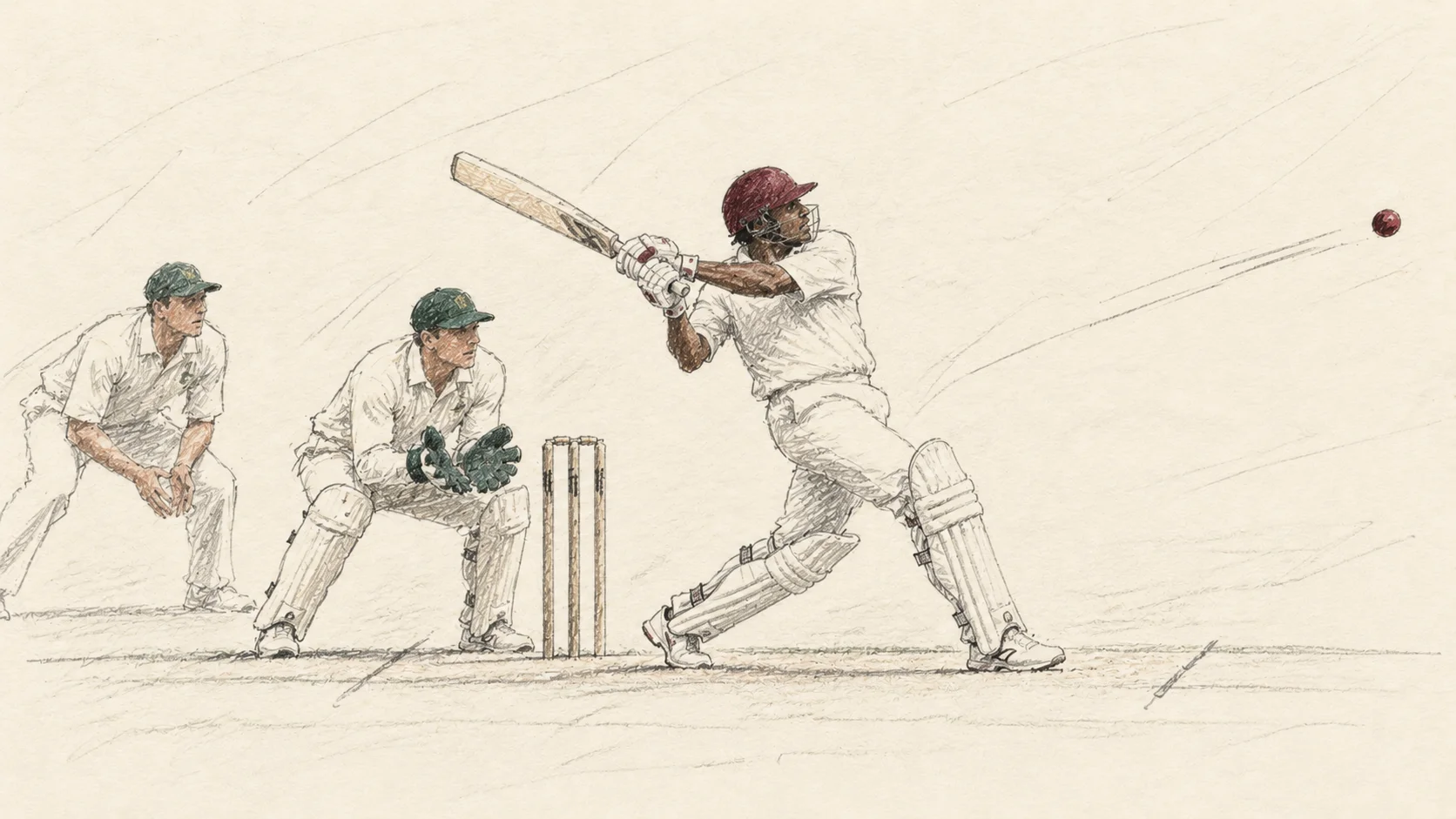
He can get to the pitch of the ball, make a full delivery of something intended to test him, or move back and punish the shorter one. The width of his scoring options gives Waugh more places to defend. Every defensive field change can offer Lara another way to keep the innings moving.
Warne’s name still carries all its authority. His shoulder and rhythm have to provide the bowling behind it.
Lara reaches fifty with a six off Warne. The first fifty takes 118 balls.
The next fifty takes 51.
That shift is one of the reasons I want to spend time with the whole innings. It begins with restraint, and the restraint has a purpose. As the attack changes and the chances to score improve, Lara changes with them.
Adams keeps the other end in use. He eventually makes 38 from 125 balls.
Thirty-eight is an easy number to overlook beside 153. One hundred and twenty-five deliveries is a much more substantial investment. For all those balls, Australia are still trying to remove a recognised batter rather than working through the bowlers beneath him.
Together, Lara and Adams add 133.
The score reaches 238 for five. Only 70 remain. Lara has a hundred, and West Indies have a partnership that appears capable of finishing the job.
McGrath has another spell available.
Sixty Runs and a Tea Break
McGrath bowls Adams with a delivery that beats his defence and hits off stump.
Jacobs comes in. A little later, McGrath gets him lbw. Perry follows on the next ball, also lbw.
The partnership that has made victory seem manageable is gone. So are the next two batters.
Three wickets. Ten runs.
At 248 for eight, West Indies need 60. Lara is left with Ambrose and Walsh.
Ambrose has to face the hat-trick ball. He survives it.
By tea, West Indies have reached 254 for eight. Lara has 112. Ambrose has yet to score.
Fifty-four runs to win. Two wickets left.
Tea.
Obviously.
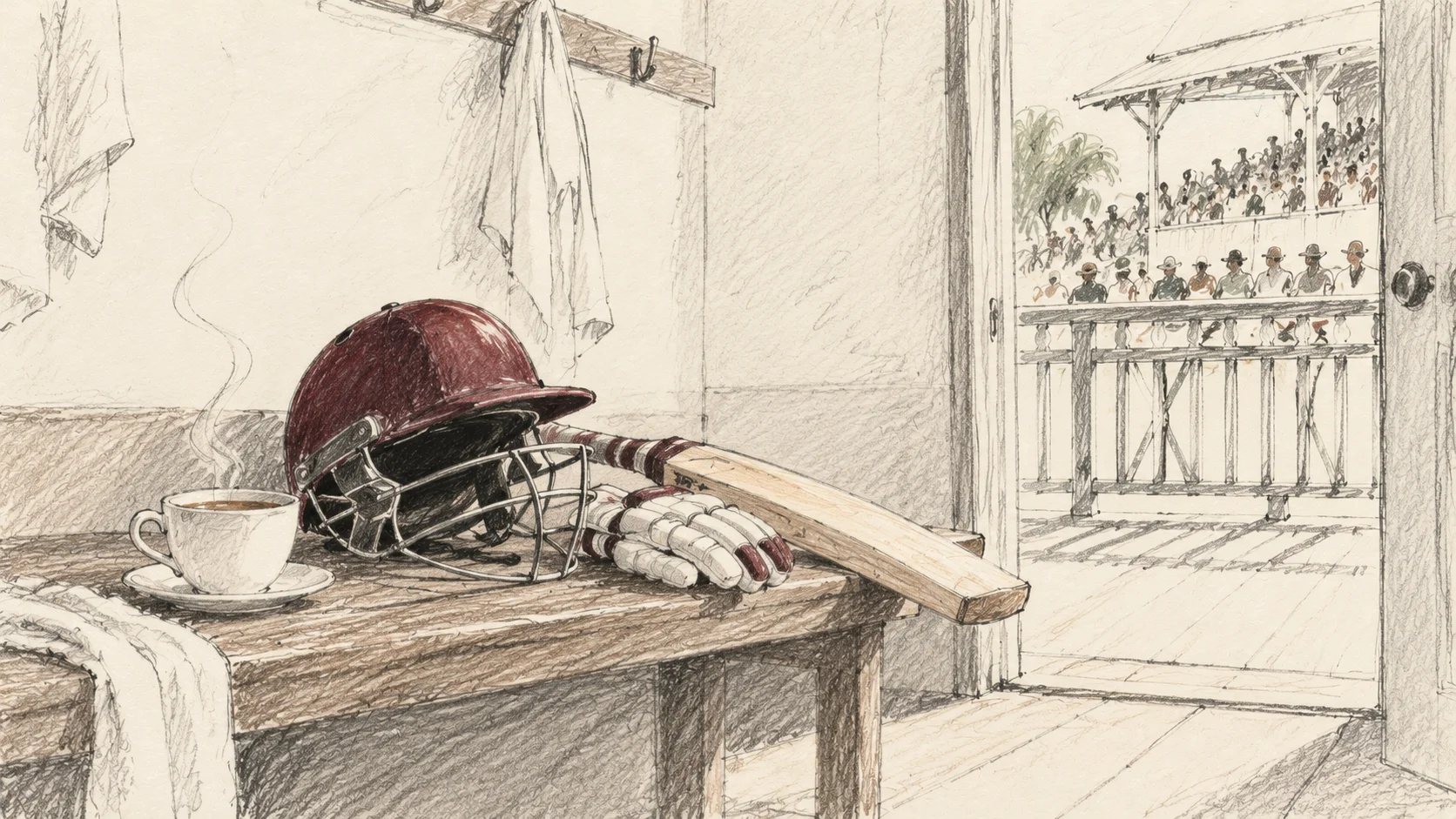
I like this absurdity about Test cricket. The situation can feel close to a collective medical emergency, and the game still insists on an interval.
For the people watching, the pause offers ample time to calculate the same equation repeatedly and arrive at no more reassuring an answer.
For Australia, it offers McGrath a rest. He has already bowled 38 overs in this innings. The break has a direct bearing on the quality of the deliveries Lara will have to face next.
For Lara and Ambrose, it interrupts a partnership whose first task has been to stop the collapse.
This is part of the contest too. A match is shaped by the periods in which nobody is adding to the score: a bowler recovering, a batter waiting to begin again, a dressing room doing whatever it considers necessary to remain useful.
In Perry’s case, that involves a table.
When play resumes, Ambrose still has the smallest number beside his name.
It is about to become a very large twelve.
Twelve Runs That Matter
Lara has to score the runs and arrange who faces the bowling.
Those tasks do not always agree.
An easy single early in the over can leave Ambrose facing five deliveries. Refusing it preserves Lara’s control, but the run still has to be found later. A boundary removes some of that problem. A dot ball can restore all of it.
This is the craft inside the familiar phrase farming the strike. The score is moving toward a target while the batter is also managing the next six balls. The fielders know what he wants. They can make the early single inviting and the late one difficult.
Ambrose has his own work to do. He defends, gets through the deliveries that reach him, and eventually finds two boundaries.
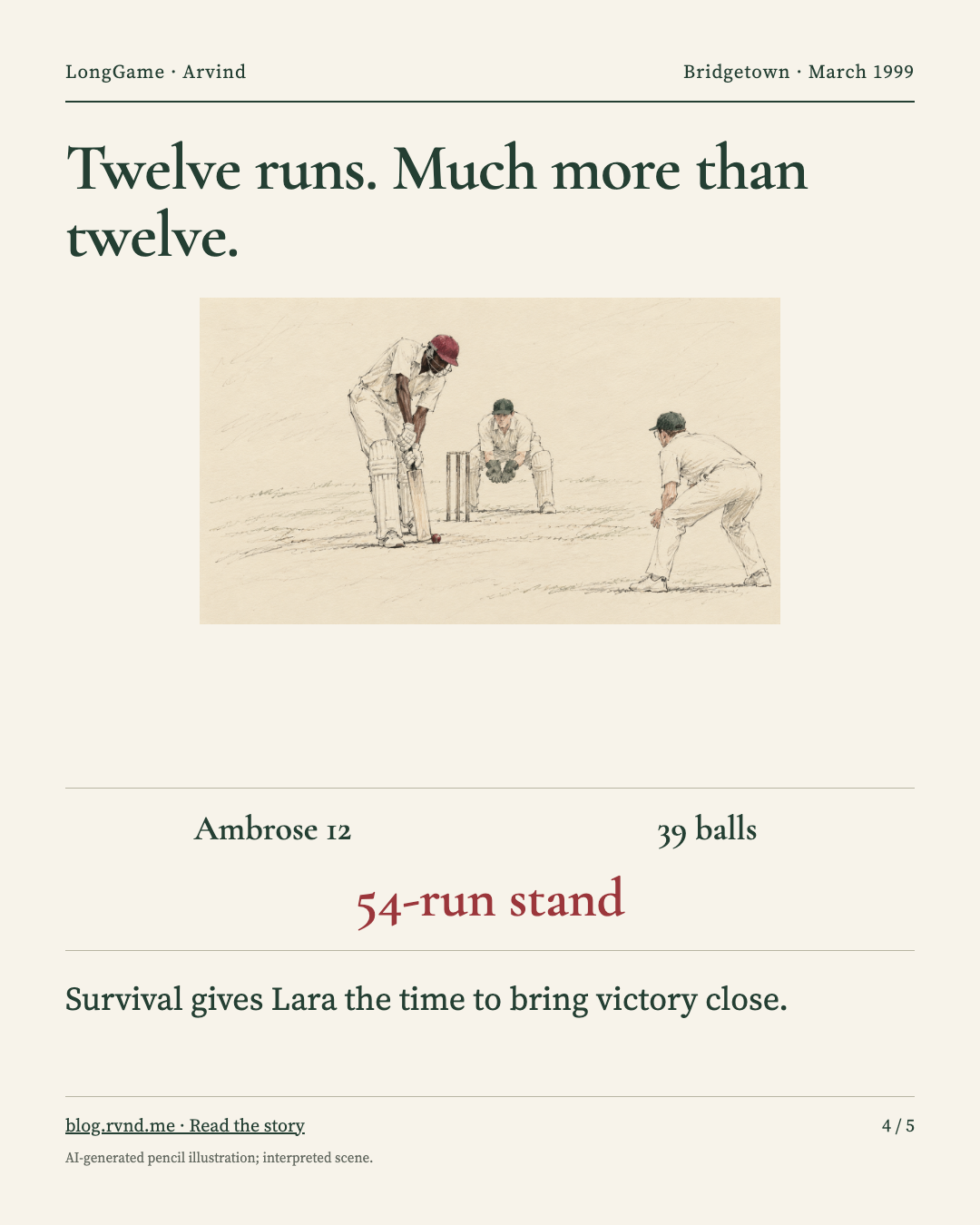
He stays for 39 balls. His twelve runs take 82 minutes.
That is a long time to ask a bowler to remain useful with a bat while a Test match is balanced on two wickets. He does it while facing opponents who are still capable of producing the ball that ends the partnership.
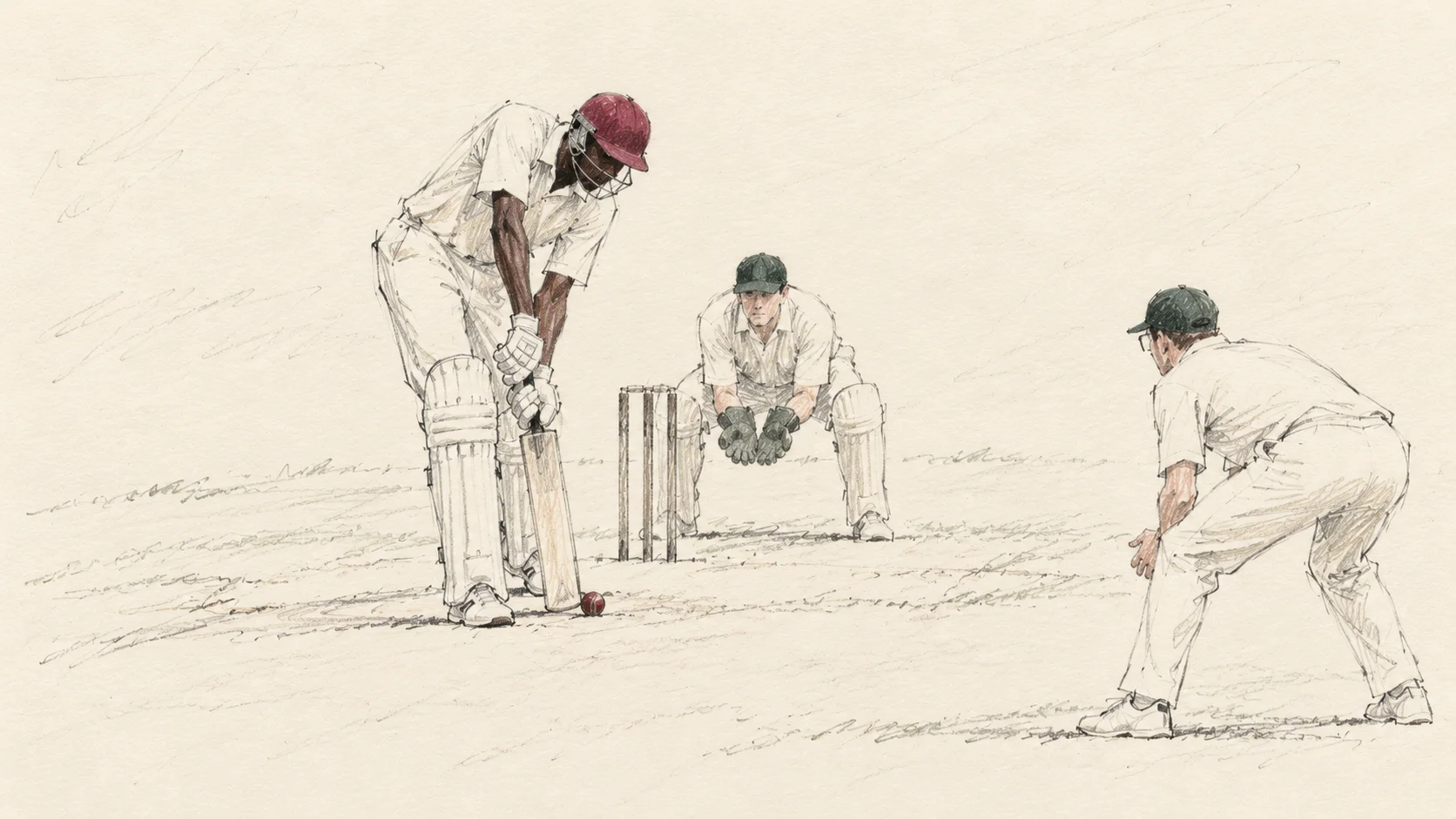
The runs come close enough now to make everyone start counting them individually.
At 301 for eight, Lara has 145. Seven runs remain.
Gillespie finds his edge.
Healy cannot hold the chance.
There is the opening Australia have worked for. There is the reprieve West Indies need. An innings can be extraordinary and still require a delivery to escape the hands waiting behind it.
Healy is also playing with injured calves. That belongs in the story of the missed catch. So does Gillespie’s back, and the workload in McGrath’s legs. By the final session, the names in the scorecard are carrying several days of physical effort.
Lara takes a single. Then Gillespie gets Ambrose: an edge to Elliott in the slips.
The partnership is worth 54. West Indies are 302 for nine.
Six to win.
And now, Courtney Walsh.
An Ovation for Leaving It Alone
Walsh walks into a situation for which his bowling record offers considerably more reassurance than his batting record.
He is the last man. There are three legal deliveries left in Gillespie’s over.
A no-ball provides a run. Walsh survives the deliveries around it, including a yorker he manages to keep out. At the end of the over, West Indies are 303 for nine.
Five to win. Lara is back on strike.
McGrath begins his forty-fourth over of the innings.
Pause on that number for a moment. Forty-four overs, after 33 in the first innings. This is a fast bowler who keeps returning to a contest that has repeatedly looked within his reach. He will finish with five for 92. He has done enough to make West Indies earn every remaining run.
Lara edges two past the slips. Then come three deliveries without a run.
A wide reduces the requirement to two. Lara takes a single from the next delivery, a hook into the ground, and the scores are level.
Walsh must face the last ball.
There is a small but important change now. Australia can no longer win; the last wicket could still make this a tie. West Indies still need one run to turn all their work into victory.
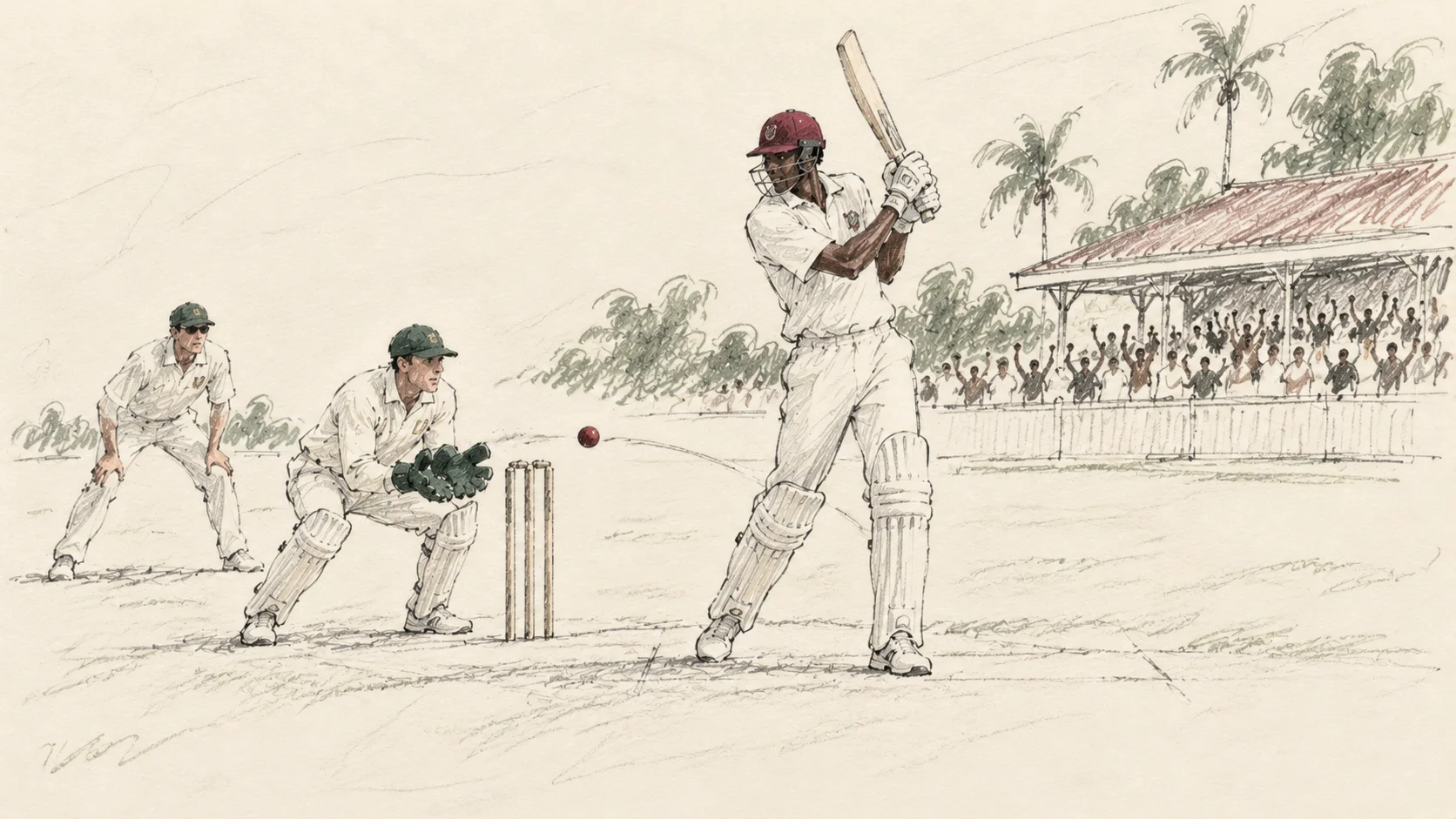
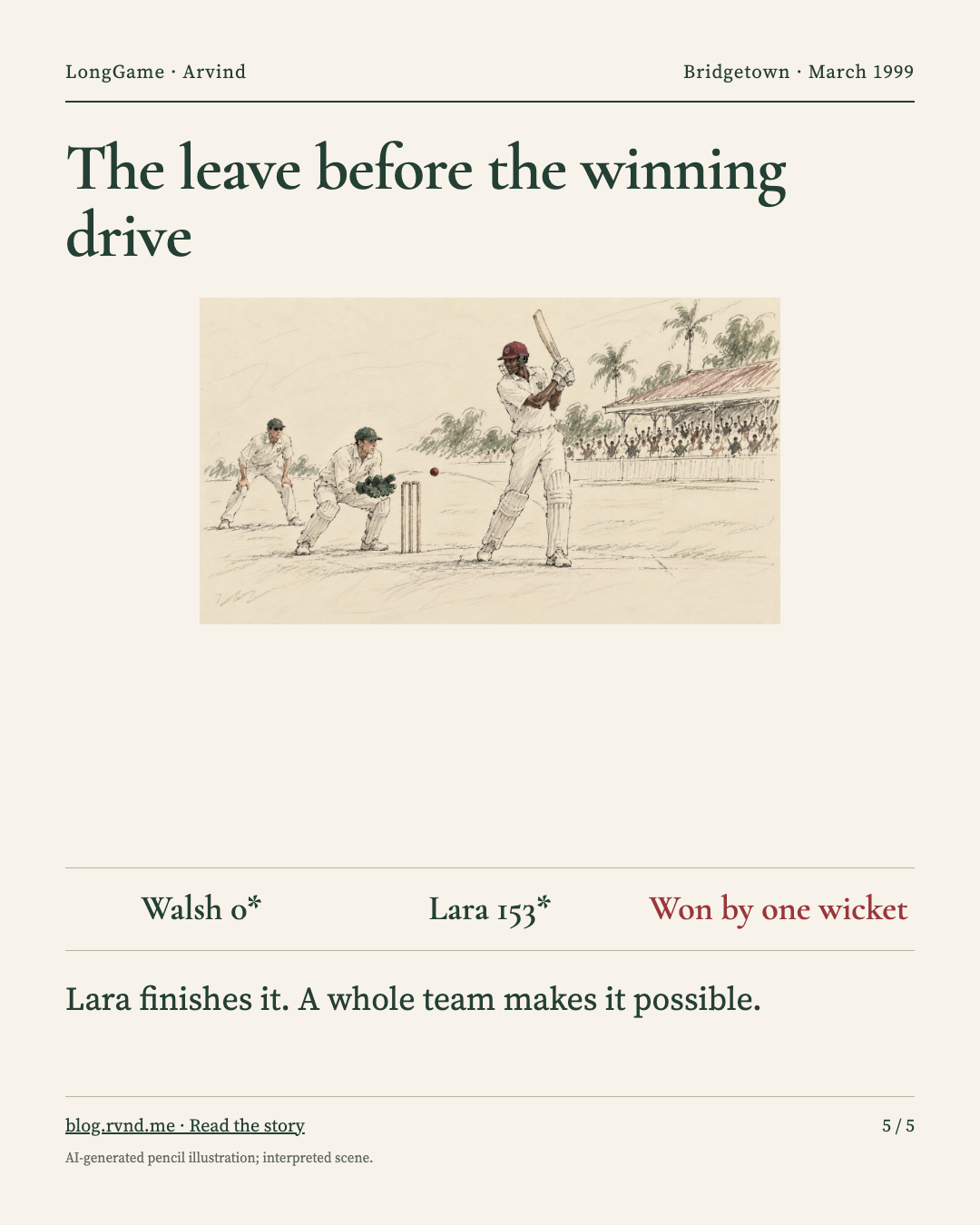
McGrath bowls outside off stump.
Walsh watches it pass.
The bat stays out of its way.
The ground has an excellent reason to applaud.
I think this is where Test cricket explains itself particularly well. The value of a leave depends on everything that has put the batter in front of that delivery. Here, doing nothing with the bat is the action everyone needs.
Walsh’s entry in the scorecard will read zero not out from five balls. The archived commentary preserves the sequence: the no-ball, the survival, the wide, the single, the final leave.
West Indies are 307 for nine.
Lara has 149.
And Perry, hearing that the scores are level, finally comes out from under the table.
One run should do. Four will do Nicely.
Gillespie runs in.
His first delivery of the new over offers width. Lara drives through the covers.
Four.
The score moves from 307 to 311. Lara finishes with 153 not out. West Indies win by one wicket and lead the series 2–1.
At 4.26 in the afternoon on 30 March, the tension that has accumulated across five days has somewhere to go. Teammates rush out. Spectators follow. The ground can stop calculating and start celebrating.
The last shot is beautiful. It is also the final act of a match that keeps being made possible by someone else.
Campbell’s hundred. Jacobs’s 68. The runs that get West Indies past the follow-on. Walsh’s five wickets. Ambrose and Collins sharing the work. Griffith’s long second-innings stay. Adams’s 38. Ambrose’s twelve. Walsh’s zero.
Each contribution changes what the next person is allowed to attempt.
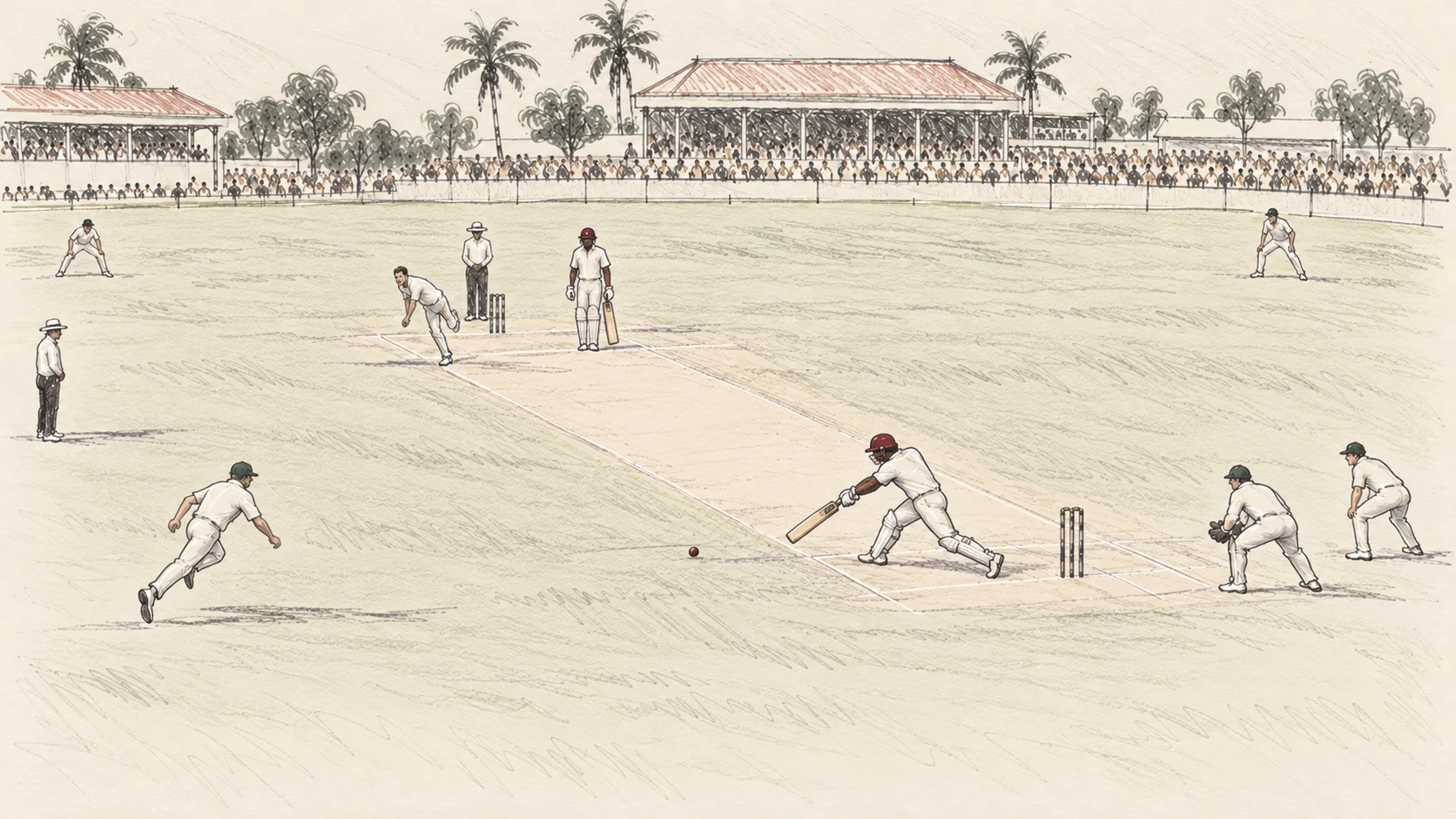
That is why I want LongGame to spend time with the whole Test. Lara’s innings grows more remarkable when we can see the situation around it: the advantage Australia build, the recoveries they interrupt, the quality of the bowling they bring back for the final effort.
Waugh’s 199 and Ponting’s 104 remain excellent innings. McGrath and Gillespie make the chase a contest until the end. West Indies have to find several ways of staying in the match before Lara can finish it.
There is no convenient permanent recovery waiting beyond the boundary either. Australia win the fourth Test in Antigua. The series finishes 2–2. West Indies do not suddenly return to their old position in the game.
Bridgetown is still worth all the time it asks of us.
Look at how much meaning fits into those last two deliveries. Walsh earns an ovation for a ball he does not hit. Lara sends the next one to the boundary. A captain who began the series under review leaves the field with his team ahead.
And somewhere behind the celebration is a man who has spent the decisive part of the afternoon beneath a table, still dressed to bat.
Cricket is an odd business.
I am very glad it has room for five days of this.
LongGame — Test cricket. Worth the wait.
One story. Every month. Get LongGame.
Sources and illustrations
Scores, dismissals and intervals are checked against the Cricinfo match record and its five-day commentary archive. Contemporary context comes from Rick Eyre’s daily reports, Tony Cozier’s reports for the Trinidad Express, and the captaincy announcement linked above. Perry’s dressing-room recollection and players’ retrospective accounts appear in Adam Burnett’s Cricket Australia oral history.
The illustrations are AI-generated pencil interpretations of the match, not documentary reconstructions of the field settings.